RUNE POEMS · LIVING SIGNS · INTERPRETATION
Rune Divination Meanings: From Name to Living Sign
A rune does not arrive carrying one English keyword. Its sound, name, poetic witnesses, place in a cast, and the question asked all press upon one another until meaning becomes an argument.

STAR & SIGIL
Learn the force hidden inside each stave
Enter a study working that joins rune name, poetic image, active verb, and remembered reading into one durable vocabulary.
Study the living staves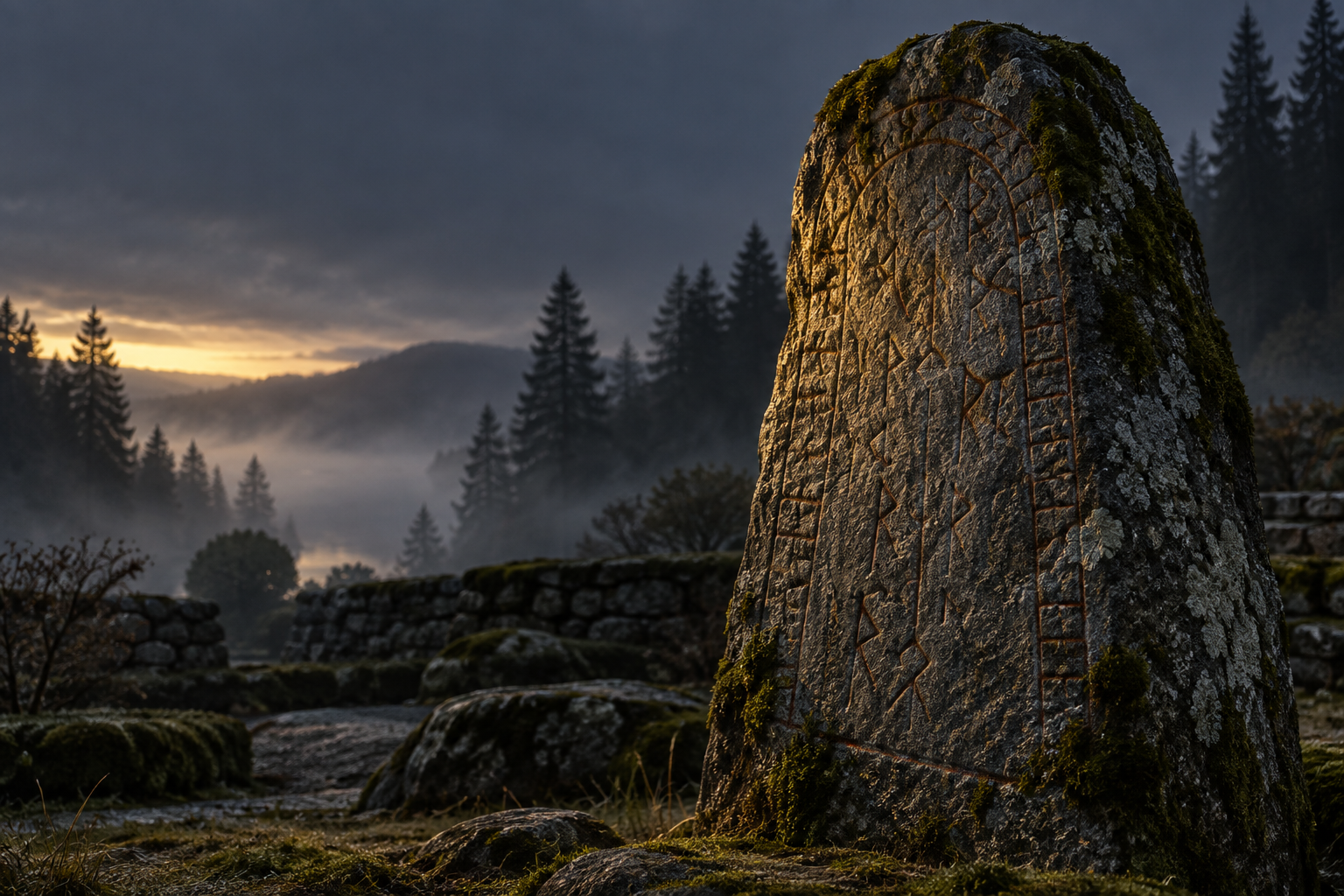
Three staves lie on the felt: wealth, riding, need. The easy reading writes itself before the reader can resist it—money is coming, travel will follow, hardship will end. Yet Seline, who drew them before the buyer’s hired diviner, is not asking about a holiday or a windfall. She is deciding whether to sell the mountain rescue dogs she trained after an avalanche closed the only road to her valley.
Rune divination meanings do not live in one-word substitutions. A rune begins as a character in a historical writing system. Its conventional name may evoke an animal, substance, social fact, or force. A rune poem may complicate that name through praise, danger, labor, irony, or obligation. Modern divination adds another interpretive layer: position, relation, orientation, question, and a reader’s declared method.
The honest reader does not flatten those layers into “the ancient meaning.” She lets them contend. A sign can name wealth while its poem asks who must share it; it can name riding while distinguishing the rider’s comfort from the horse’s labor; it can name need while refusing to promise that constraint will simply disappear.
01 / FIVE LAYERS OF MEANING
A stave is not born as an oracle card
The first layer is graphemic: the sign belongs to a runic row and carries a sound value within a language. Elder Futhark, Younger Futhark, and the Anglo-Saxon futhorc are related systems, not interchangeable fonts. A modern twenty-four-piece divination set usually adopts Elder Futhark forms; the poems most often recruited to explain those forms survive in later Old English and Scandinavian settings.
The second layer is the rune name. Some Elder Futhark names are reconstructed by comparing later evidence and historical linguistics. Reconstruction is disciplined scholarship, but it is not the same as finding a twenty-four-rune divination key carved beside an early inscription.
The third layer is poetic witness. Rune poems build memorable verses around names, often presenting tension rather than definition. The fourth is modern convention: a reader may adopt “resources,” “journey,” or “constraint” as working prompts. The fifth is the living cast, where the question and neighboring signs narrow which sense matters now.
FROM STAVE TO LIVING SIGN
Form and sound
Which historical row supplies the sign, and what sound did it carry?
Name
What noun or being names the rune, and is that name attested or reconstructed?
Poetic image
What tension does a particular rune poem create around the name?
Modern rule
Which contemporary keywords, positions, or orientations has this reader declared?
Question
Which part of the image can answer the actual matter without swallowing it whole?
02 / THE POETIC WITNESSES
Rune poems remember through conflict
The Old English Rune Poem does not treat Feoh as a flat promise of cash. Wealth is a comfort, yet the verse turns immediately toward distribution and reputation: possession becomes a question of what circulates and what kind of name its holder earns. A modern reading that stops at “abundance” amputates the social consequence that makes the image interesting.
Rād, riding, changes according to viewpoint. Indoors, riding may seem easy to the warrior; on the road, the horse experiences strenuous labor. The image therefore contains journey, privilege, vehicle, effort, and the unequal body bearing the movement. “Travel” is not wrong. It is only unfinished.
Nȳd, need, is constriction in the breast, yet the verse also suggests that need can become a kind of help when recognized in time. That does not turn deprivation into a blessing. It gives constraint an interpretive double edge: pressure can injure, and accurately naming pressure can direct action.
The Norwegian and Icelandic rune poems preserve other rows and other images. A cognate name does not guarantee an identical verse, and a later verse does not automatically reveal how every earlier carver understood a sign. The poems are witnesses in conversation, not chapters torn from one primordial handbook.
| Rune layer | What it contributes | What it cannot claim alone | Seline’s reading |
|---|---|---|---|
| Feoh / wealth | Resources, comfort, circulation, reputation | Guaranteed incoming money | The dogs are valuable, but value includes the rescue capacity shared across the valley. |
| Rād / riding | Movement, vehicle, route, unequal labor | A command to leave | A buyer’s easy departure would be carried by animals and trainers who bear the cost. |
| Nȳd / need | Constraint, urgency, disciplined recognition | Punishment or inevitable misery | The closed road creates a real cash crisis; naming it clarifies the decision without sanctifying it. |
03 / THE QUESTION’S GRAVITY
The same rune changes office when the question changes
“Will I prosper?” makes Feoh absorb almost any desirable event. “What resource am I misvaluing in this sale?” gives the sign a narrower task. Seline’s dogs have market price, trained skill, social trust, ongoing cost, and living needs. Wealth can point to any of these, but the question makes their conflict visible.
Rād behaves differently under “Should I leave?” than under “Who carries this movement?” The first tempts a yes-or-no verdict. The second exposes the journey’s infrastructure: the truck, the blocked pass, the buyer, the handler, the dogs, and the communities that depend upon them. Position does not create an automatic grammatical sentence, but it can make a reader ask which sign describes condition, action, or consequence.
When Seline needs to see the precise hinge rather than force three runes into a verdict, she can cast Hold the Turning Moment. It reveals the exact moment her choice changes her life and holds that instant open until she decides. The spell does not translate Feoh or Rād for her; it brings the decision-point itself into view, where the reading can be compared with an event rather than inflated into fate.
ILLUSTRATIVE CASE THE ROAD BENEATH THE RIDER
Three favorable keywords conceal who bears the journey
Suppose Seline’s valley has been isolated for nine weeks after a rockfall. Feed costs are rising. A private security company offers enough money for all four trained rescue dogs to clear her debt, provided it can collect them immediately. Its negotiator brings a diviner hired to discover whether Seline will sell and which future pressure will make her agree.
Feoh, Rād, Nȳd: wealth arrives, travel opens, need ends. The diviner announces that he has already seen Seline sign and treats each objection as one more road toward the same foregone sale. The buyer calls the sequence “astonishingly clear.” Every verb in the reading benefits the purchaser.
What circulates?
The sale price would relieve Seline, while the dogs’ trained value leaves the valley.
Who carries whom?
The buyer gains an easy acquisition; the dogs, handlers, and isolated residents bear the road’s labor.
Whose constraint?
Seline’s debt is immediate, but the valley’s emergency need persists beyond the sale.
What follows?
Placed last, need does not promise release. It asks what necessity the proposed movement creates next.
THE TURN IN THE CAST
When Seline reads the staves from the dogs’ side of the bargain, she discovers the company does not need all four animals; its contract requires only proof of a trained unit. The extravagant offer was designed to eliminate a local competitor. Feoh describes concentrated purchase as readily as welcome abundance. Rād exposes whose movement is made easy. Nȳd remains after the money changes hands.
04 / RELATION BEFORE DICTIONARY
Neighboring staves alter the argument, not the alphabet
Rune combinations are often treated like compounds in a secret language: wealth plus journey equals profitable travel. That arithmetic is seductive because it eliminates ambiguity without requiring grammar. A divinatory cast is better read as an arrangement of pressures. Does one sign qualify another, oppose it, reveal its cost, or show what follows?
Seline’s Feoh does not cease to mean wealth when Nȳd appears. The question becomes whether wealth relieves need, exploits it, or merely transfers it. Rād between them can be a bridge, an extraction route, a necessary expedition, or the labor through which one condition becomes another. The actual offer, terrain, timing, and interests decide which relation can survive scrutiny.
Repetition also requires restraint. Three appearances of the same rune may indicate emphasis within a declared method, but they may also reflect handling, tile shape, a favored narrative, or chance. Repetition intensifies attention; it does not exempt interpretation from context.
05 / THE PACK INSIDE THE NUMBER
Four sale units may be one living instrument
The buyer prices four animals. Seline knows a rescue unit. One dog ranges ahead, one holds scent through broken ground, one signals, and one stays close enough to return a handler along the safest line. Their value is relational: separating the bodies can destroy a capacity that belongs to the pack.
To make that collective office magically undeniable, Seline can cast The Many Beasts as One, calling every beast within hearing and commanding them as one great creature. The four dogs answer as the single rescue intelligence she trained, exposing what the purchaser’s arithmetic erased: Feoh counts wealth badly when it counts bodies but not the power among them.
Rād then belongs to more than transport. It describes coordinated movement across dangerous ground. Nȳd belongs to the valley’s actual constraint: not merely feed debt, but the need to preserve a working whole. The cast changes because its subject has been identified correctly.
06 / REVERSALS AND BLANKS
A modern rule must declare itself before it can speak
Not every rune has a visually stable upright and reversed form. Some are symmetrical; orientation varies with script, object, and viewpoint. A reader may decide that inversion modifies a meaning, but that is a modern rule of the chosen oracle. It should be declared before the cast, not invented afterward to rescue a preferred story.
The blank rune belongs to the same category of declared modern practice. It is not part of the historical twenty-four-rune Elder Futhark row. A reader may use a blank tile for the unknown, withheld, or unformulated, but should not present it as an ancient lost rune whose silence authenticates every mystery.
Clarity about invention does not make a method powerless. It makes the agreement visible. The reader knows when she is studying a historical witness, when she is using a contemporary convention, and when a personal association enters. Those different voices can then disagree without one impersonating all the others.
07 / THE LIVING SIGN
The strongest meaning survives contact with the world
Seline does not ask the staves to decide whether to sell. She tests the buyer’s claim, speaks with the volunteer rescue team, prices a smaller transfer, and discovers that keeping two dogs while leasing one trained pair would relieve the immediate debt without emptying the valley of capacity. The waking arrangement is not hidden inside the runes. The cast made the conflict legible enough to negotiate.
Feoh remains wealth, but wealth is now circulation and reputation as well as price. Rād remains riding, but the horse’s labor has entered the account. Nȳd remains need, but need is no longer a theatrical promise that hardship will vanish. It is the constraint around which a less extractive road must be built.
A living rune meaning is neither a museum label nor an intuition freed from evidence. It is a disciplined encounter among letter, name, poem, modern rule, neighboring signs, and a question with real stakes. The reading succeeds when none of those voices has to pretend it spoke alone.