HIDDEN OBJECTS · HOUSE ARCHAEOLOGY · PROTECTION
Magical House Deposits: How to Read Objects Hidden in Buildings
A shoe in a chimney, a bottle under a hearth, and a scored mark above a door can all look like household magic. Their locations speak loudly—but they do not all speak the same language.

STAR & SIGIL
Make the house witness care in plain sight
Continue into a cataloged protection working whose boundary stays visible and maintained instead of becoming a hazardous deposit for future occupants.
Open the visible house witness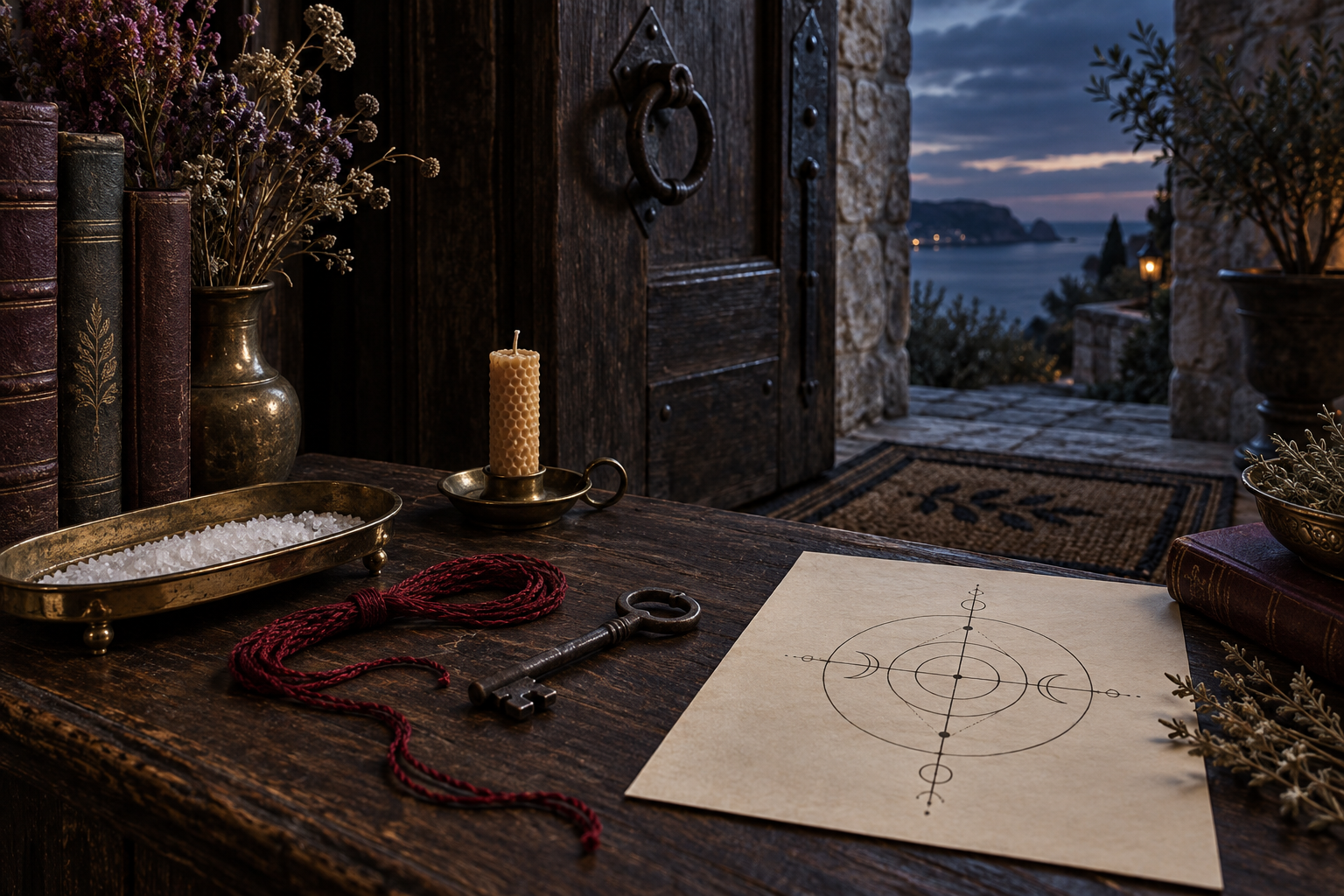
A child’s shoe appears when plaster is lifted from a chimney breast. Its leather is cracked, its toe bears the shape of a long-absent foot, and no matching shoe lies nearby. In another house, builders find a stoneware bottle beneath a hearth, packed with bent pins and human hair. Both discoveries are tempting to call protective magic. The temptation is not yet an interpretation.
Magical house deposits are objects deliberately placed within a building’s fabric or at one of its boundaries: under floors, inside walls, beside hearths, above ceilings, beneath thresholds, and among roof timbers. Some were probably intended to protect, contain, memorialize, bless, or mark a change in the house. Others are losses, rubbish, pest remains, builders’ jokes, practical storage, or later intrusions. The expert question is not “What magical object is this?” but “What relationship joins this object, this location, and this moment in the building’s life?”
Location is part of the object
A worn boot in an attic trunk is stored property. The same boot sealed behind a fireplace during construction has entered a different grammar. Hearths, chimneys, doors, windows, rooflines, and foundations are joints through which smoke, weather, bodies, animals, goods, and imagined danger pass. A deliberate deposit at such a joint may act less like a portable charm than like a valve placed in the house’s circulation.
That is why removal destroys information. Which side of the wall faced the shoe? Was its toe aimed toward the room or the chimney? Did mortar close the cavity once, or was it reopened during a Victorian renovation? Nearby dust layers, nail holes, tool marks, timbers, and associated scraps can identify a deposition episode more securely than the object’s dramatic appearance. A photograph taken after everything has been cleaned and arranged cannot recover those relationships.
Houses also accumulate time unevenly. A seventeenth-century wall can contain a nineteenth-century repair and a twentieth-century cable chase. “Found in an old house” does not date a deposit. Building sequence, manufacture, wear, and access must agree before an interpretation becomes persuasive.
Concealed shoes preserve wear, personhood, and uncertainty
Concealed shoes are often old when deposited, heavily repaired, and found singly. Their interiors have been molded by gait, labor, injury, and repeated use; a shoe can therefore carry an unusually intimate negative impression of its wearer. Researchers have proposed that this bodily likeness represented a resident, retained a dead family member’s presence, lured a harmful force into a foot-shaped trap, marked construction, or echoed tales in which footwear catches the Devil.
No single proposal explains the whole corpus. A child’s shoe near a threshold may invite a different reading from several adult shoes with garments and tools beside a chimney. Even the frequently repeated claim that concealment was protective can become circular: the shoe is called protective because it was concealed, and concealment is then proven protective by the shoe.
Assemblages carry more weight than isolated resemblance. A cache combining shoes, a cord, deliberately broken vessels, textiles, and animal material in an inaccessible cavity looks more selected than one boot near builders’ debris. Yet selection does not identify one universal rite. A household could retire personal objects, commemorate occupancy, place a safeguard, and reuse a convenient void in the same act.
A house may also be imagined as possessing a second body: skins at its edges, apertures that inhale, and objects stationed like organs. The Other Self Made Flesh turns the double into an explicit enchantment, creating a living counterpart that carries out your will while you remain elsewhere. Undertake it where a true acting double is desired; an undocumented shoe in a wall makes no such specific claim.
Witch bottles form a narrower—but still varied—category
So-called witch bottles concentrate the idea of counteraction. Early examples include stoneware or glass vessels containing bent pins or nails, hair, nail clippings, cloth hearts, urine, and other bodily matter. Written and oral accounts connect some bottles with cures for bewitchment: material associated with an afflicted person and sharp contents could trap, torment, or turn an attacking influence until the suspected witch relented.
This is not the same logic as a concealed shoe. The bottle is a bounded container whose contents create pressure and address an affliction; the shoe is an open bodily trace whose operation must be inferred. Nor did every unusual bottle serve counter-witchcraft. Context, residue analysis, vessel date, stopper, deposition, and comparison with documented finds matter. A bottle beneath a hearth, one recovered from a ditch, and a modern bottle abandoned beside water do not automatically belong to a single lineage.
Modern imitation also creates real hazards. Pins, glass, organic matter, liquids, and tightly sealed vessels can injure workers, animals, and future occupants. Hiding one in rented property or a historic structure changes somebody else’s building without consent. Magical seriousness does not require manufacturing misleading archaeology.
Shoe, bottle, and scratched mark at one hearth
Suppose renovation exposes three things around an eighteenth-century fireplace: a child’s left shoe in a sealed side cavity, a stoppered stoneware bottle under the later hearth slab, and intersecting scorch-dark lines cut into an exposed roof timber above. Their proximity is striking. Their evidential lives are not identical.
| Find | What the object securely shows | What remains interpretive |
|---|---|---|
| Worn child’s shoe | Personal wear; singular selection; placement when the side cavity was closed | Protection, memorial presence, trapping logic, or practical disposal |
| Sealed bottle | Deliberate container; contents and vessel can be dated and examined | Counter-witchcraft only if contents and context support that narrower reading |
| Intersecting timber marks | Marks were cut, not naturally split; tool sequence may be visible | Protective sign, carpenter’s assembly mark, tally, later graffiti, or overlap |
The fireplace does not merge the three into one rite. First, construction sequence may show that the shoe predates the hearth slab by a century. Second, laboratory examination might reveal the bottle contains only dried ink rather than pins or bodily matter. Third, the timber cuts may match carpenters’ marks elsewhere in the roof. The initial magical cluster then separates into three histories.
If the bottle instead contains bent pins and hair, sealed beneath an undisturbed contemporary hearth, counter-witchcraft becomes a stronger explanation for that object. It still does not prove why the shoe was placed or convert the roof marks into apotropaic signs. Good interpretation can increase confidence locally without making the whole building obey one story.
Protective marks, assembly marks, and damage can resemble one another
Buildings preserve circles, intersecting lines, daisy wheels, grids, burn marks, and letters near openings. Some marks are plausibly apotropaic: repeated placement at vulnerable passages, deliberate compass construction, and meaningful forms can support a protective reading. But masons, carpenters, owners, children, merchants, and later visitors also marked buildings. A “witch mark” identified from shape alone risks turning every scored timber into occult evidence.
Distribution provides the best correction. Does the same symbol recur at doors and fireplaces but nowhere else? Are apparent burn marks tapered and repeated in ways inconsistent with accidental scorching? Do cuts lie beneath later paint, or slice through it? Does an assembly mark have a matching partner where two timbers join? The building supplies a comparative collection if the observer resists choosing the most exciting specimen first.
This distinction matters in living homes. A person may choose a protective sign now, document its date, and keep it removable without claiming descent from every historic mark it resembles. The Door No Malice Can Remember bars a named adversary from finding or crossing one chosen threshold. Cast it where both adversary and boundary are known; that precision shows why “protection” is too broad a label for unidentified scratches.
The finder inherits responsibilities before a secret
When an object appears during work on an older building, stop disturbance where it is safe to do so. Record the find in place, including scale, orientation, nearby materials, the opened layer, and the part of the structure. Do not empty bottles, pull pins, scrape residues, inhale dust, handle animal remains, or climb into unstable voids. Owners, contractors, conservators, archaeologists, and the relevant heritage authority may each hold necessary knowledge.
The ethical stakes extend beyond physical safety. Human hair and garments can retain intimate associations; animal remains deserve sober treatment; personal papers may identify families; culturally sensitive material may require specialist care. Reburial, retention, display, and disposal are not interchangeable responses. The person who happens to lift the board does not automatically become the object’s sole interpreter.
Magical house deposits reward patience because their power, historically understood or newly imagined, lies in relationship. Object without placement becomes a curiosity. Placement without building history becomes atmosphere. A persuasive reading holds artifact, architecture, sequence, comparison, and uncertainty together.