LOVE CRYSTALS · STRUCTURE · PLACEMENT
Love Spell Crystals: Choose Stones by Ritual Function
A stone does not become romantic because it is pink. Love-crystal work becomes precise when color, transparency, fracture, polish, weight, and placement are assigned different offices in the relationship field.

STAR & SIGIL
Set desire into a visible geometry
Continue with an attraction working that gives longing a center, balanced approaches, and a material form clear enough to read.
Arrange the heart stones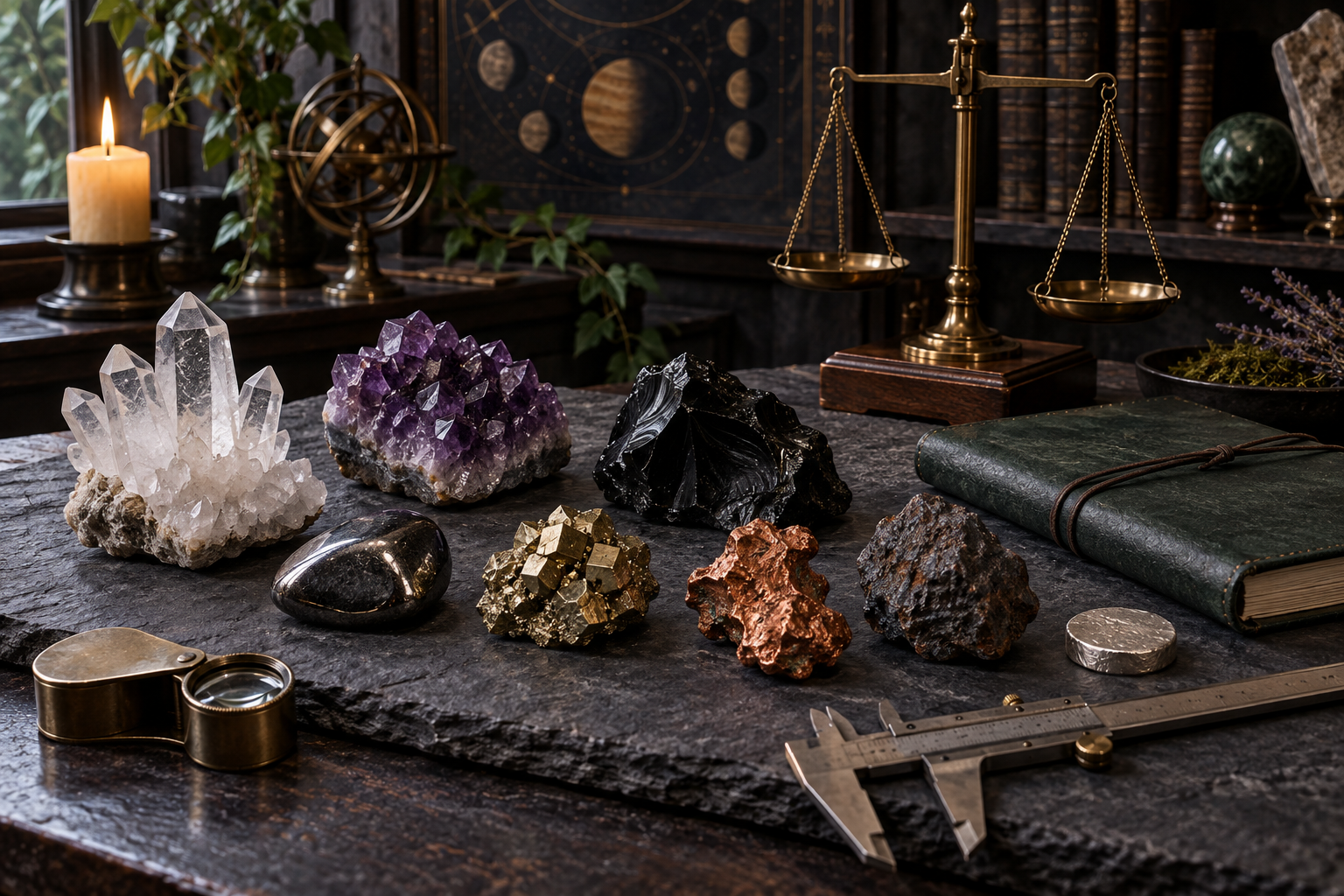
Stone slows the love question down. A polished face catches light immediately, but a crystal’s structure was not made at the speed of a glance. That tension—instant visibility, immense formation—gives love-spell crystals their most useful grammar.
Mineral facts and magical meanings belong in different sentences. Quartz is crystalline silica; garnet names a mineral group rather than one substance; moonstone’s floating light is an optical effect associated with feldspar structure; rhodonite is commonly pink to red with darker veining. None of those properties scientifically proves a supernatural romantic effect. Each can, however, provide disciplined symbolic material.
The expert question is not “Which crystal means love?” but “What must become visible, contained, intensified, or refused?”
01 / FIVE STONE OFFICES
Transparency, flash, grain, and weight change the argument
| Stone | Observed feature | Love-magic office | Placement logic |
|---|---|---|---|
| Rose quartz | Clouded pink translucence | Tenderness that remains partially private | Near the person whose self-regard anchors the work |
| Garnet | Dense color and substantial weight | Embodied appetite and durable desire | Where heat needs gravity |
| Moonstone | Light seems to travel beneath the surface | Feeling revealed through shifting conditions | Where interpretation must change with angle |
| Rhodonite | Pink-red body crossed by dark patterning | Affection that includes fracture and repair | Between, not over, two histories |
| Clear quartz | Transparency, inclusions, defined faces | Amplification joined to scrutiny | Where a claim must remain readable |
ILLUSTRATIVE CASE THE WINDOW UNDER THE STONE
A lapidary mistakes reflected color for a client's desire
Suppose Vero cuts cabochons in a sunlit arcade. Idris, who repairs the arcade’s clocks, visits every Thursday and asks about a moonstone reserved in Vero’s drawer. At sunset its moving light casts a pale band across Idris’s face, and Vero begins treating the reflection as proof of love.
On the fourth Thursday, Vero turns the moonstone until its blue-white band crosses Idris’s eyes. He leans closer, but not toward Vero: he is measuring the cabochon against the empty aperture of a memorial clock. When the arcade bells sound, his attention leaves the stone for Sena’s morning-song schedule pinned beside the bench.
Optical event
The light moves when stone, viewer, and angle change.
Interpretive claim
Vero calls repeated attention romantic desire.
Counter-evidence
Idris asks about the stone for a memorial clock.
True revelation
His concealed desire concerns another person entirely.
THE VERDICT
Moonstone has faithfully shown a change of angle, not a declaration of love. Idris’s stated commission and the direction of his unguarded attention outweigh the romance Vero placed inside the flash. The stone can sharpen interpretation only after observation and desire are kept separate.
02 / SEE DESIRE DIRECTLY
Reflection should not carry a claim it cannot establish
Idris’s weekly visits are observable. Their meaning remains uncertain. Crystal interpretation becomes rigorous when it separates what the stone shows from what the practitioner hopes the showing signifies.
Rather than assigning his desire to moonstone’s flash, Vero can cast The Desire Burning Overhead and see Idris’s true desire above him even if he conceals it. The revelation answers the hidden-heart question directly; the moonstone is released from serving as a witness it never was.
What appears is not Vero’s name, but the image of Sena, a chorister whose voice Idris hears each morning while winding the public clocks.
03 / POLISH, INCLUSION, FRACTURE
A love stone gains meaning from what remains visible after finishing
Polish intensifies a surface; it does not remove every inclusion. In love work, that makes the finished stone a more compelling image when it reveals rather than erases complexity. A flawless-looking surface can become glamour. A visible internal feature can become testimony.
Vero suspects that the arcade’s enchanted sunset glass has beautified every weekly encounter. She can use See the Heart Beneath Glamour so she sees her own true feelings through that glamour. She discovers fondness and professional fascination, but not the romance the colored light had staged.
Rhodonite’s dark veining now offers the stronger relational image: not damage hidden beneath polish, but difference incorporated into the whole visible stone.
04 / READ THE PLACEMENT
A stone between two people makes a different claim from a stone held by one
A crystal kept close to one body may concern self-perception, desire, or protection. Set between two names, it may represent relation, exchange, or obstruction. Placed beyond them, it may embody a future toward which both look. Geometry changes the sentence.
Vero returns the moonstone to the memorial clock commission. Its traveling light now marks remembrance across changing hours—the office Idris actually requested. The most expert love-crystal reading may be the moment a beautiful stone is allowed not to mean romance.