ILLUMINATION · COMPETING CLAIMS · VERDICT
Justice Spell Candle: Light the Record, Weigh the Verdict
A justice candle is not a judge with a wick. Its light can stage examination, its paired flames can keep accusation and answer visible together, and its final flame can embody a verdict—but only if the record remains free to darken the story the petitioner hoped to prove.

STAR & SIGIL
Read the whole candle as one judicial lesson
Follow a cataloged study working, then return to the flame with each stage of testimony, deliberation, and verdict in view.
Read the candle's full verdict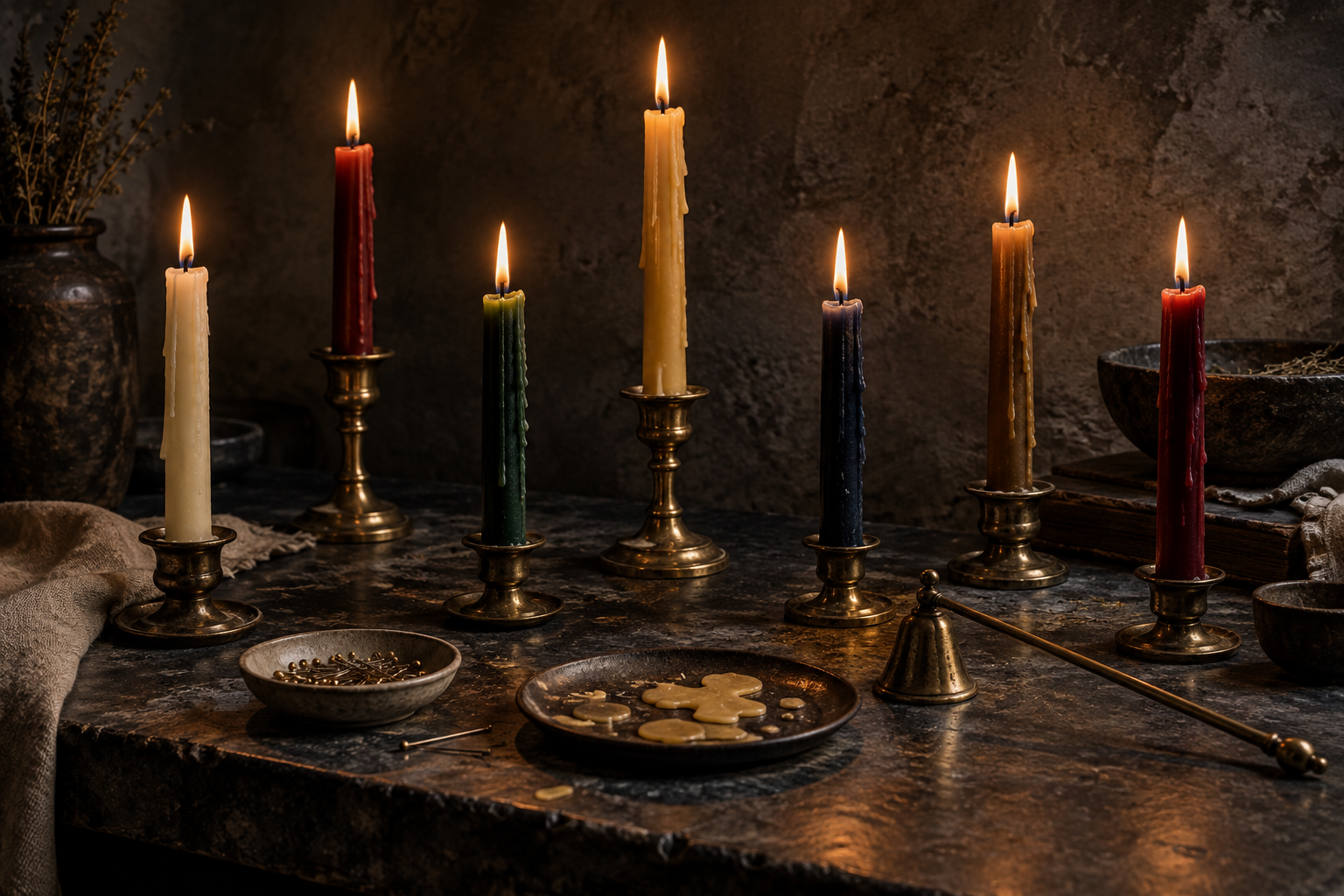
Two flames face one another across a folded accusation. The left burns low and blue; the right bends in a draft from the old window. Between them, a third candle waits unlit. It is easy to decide that one flame looks honest and the other guilty before either claim has been examined.
A justice spell candle is a theater of judgment built from light, duration, inscription, and extinction. Illumination makes a record available. Paired flames keep competing claims present. Carved words define the court’s jurisdiction. Timed burning protects deliberation from urgency. A final verdict flame embodies the decision the working is willing to authorize.
No flame becomes fair merely because it stands at the center. Justice depends upon what the candles are permitted to represent, what evidence may contradict them, and whether the final light ends with a remedy instead of feeding a permanent trial.
01 / ILLUMINATION
The first light belongs to the record, not the favorite claimant
Illumination is often treated as a synonym for truth. A candle does reveal surfaces: ink catches light, seals cast shadows, erasures become visible at an angle, and objects occupy relation to one another. But light also produces glare, hides what lies beyond its pool, and gives selected evidence theatrical importance.
In justice work, illumination is an office of attention. It asks what enters examination, what remains outside the frame, and who chose the arrangement. A letter placed nearest the flame may look central because the practitioner put it there, not because the case turns upon it.
The discipline of illumination is therefore adversarial: let the light reach material capable of defeating the accusation as well as supporting it. A record that can only confirm is an exhibit in a performance, not evidence in a judgment.
02 / THE CANDLE TRIBUNAL
Each feature carries one burden of judgment
| Candle element | Judicial office | What it can hold | What it cannot establish |
|---|---|---|---|
| Illuminating flame | Examination | The record, disputed object, question, or uncertainty under attention | That the brightest exhibit is the most probative. |
| Paired flames | Accusation and answer | Two claims present without collapsing them into equal truth | That taller, steadier, or faster-burning flame is right. |
| Inscription | Scope and jurisdiction | Named act, parties, remedy, excluded questions, and stopping line | Authority over every part of another person’s life. |
| Timed interval | Deliberation | A pause for comparison, rebuttal, and changed interpretation | That elapsed time has made weak evidence strong. |
| Wax and wick | Material record | The candle’s own combustion, residue, asymmetry, and change of state | External guilt, innocence, motive, or legal outcome. |
| Verdict flame | Decision and remedy | The theory finally authorized after claims have been weighed | That the practitioner’s judgment is infallible. |
The justice candle is strongest when no single flame is asked to be witness, evidence, judge, and punishment at once.
03 / PAIRED FLAMES
Competing claims need presence, not a beauty contest
Paired candles can give accusation and answer equal visibility without declaring them equally supported. One may hold “the cut was unauthorized”; the other, “the cut followed an order.” Their value lies in preventing the second claim from disappearing while the first is emotionally dominant.
Flame behavior cannot decide between them. Wick thickness, candle diameter, wax formulation, fragrance, pigment, room currents, and placement all alter height, movement, soot, and burn rate. A wavering answer is not a lying witness. A tall accusation is not a proven one.
The pair instead creates a disciplined question: what evidence would strengthen, narrow, or defeat each claim? If neither side is allowed to change, the candles are heraldic emblems for factions, not instruments of deliberation.
04 / THE RIGHT TO ANSWER
Authority in speech must not consume the opposing will
A justice proceeding needs claims capable of entering the room with enough force to be heard. Power differences matter: an apprentice may speak softly before an institution, a tenant before an owner, or one witness before a practiced official voice. Strengthening speech can correct that imbalance without predetermining the verdict.
A supported claim that keeps being dismissed needs authority, but an opposing will must remain able to answer. That is the exact balance held by The Crown of the Unignored Voice: spoken truth gains supernatural force without purchasing silence from anyone else. Taking up that working would give testimony weight while leaving judgment distinct from compelled agreement.
The justice candle should hold the same structure. One flame may illuminate a powerful statement while the paired flame preserves rebuttal. Being heard is not the same as winning; it is the condition under which judgment becomes more than the preference of whoever already commands the room.
05 / INSCRIPTION AS SCOPE
The carved sentence draws the walls of the court
Names alone are dangerously broad inscriptions. They turn a dispute about one act into a judgment upon an entire person. A more exact inscription identifies the contested conduct, the relevant role, the period under examination, the remedy sought, and what remains outside jurisdiction.
Direction matters only inside that sentence. Writing toward a wick may signify bringing a claim under examination, consuming an unjust assertion, or drawing evidence toward decision. Writing toward the base may signify grounding a remedy, returning consequence to origin, or fixing the limit beneath which judgment cannot descend. None is universal.
An excluded question can be as important as the demand. “Whether Carys cut the folio” differs from “whether the cut was authorized.” “Who caused the damage” differs from “who should repair it.” Scope prevents one true fact from quietly answering every other question.
An inscription is jurisdiction made visible.
What it omits should remain outside the verdict, however tempting the flame makes expansion feel.
CASE FILE THE FOLIO CUT AT MIDNIGHT
The blade marks are hers; the blame is not hers alone
Suppose Carys, an apprentice bookbinder, is dismissed after replacement leaves are cut from a rare devotional folio. Conservator Bram produces the waste paper bearing her practice cuts and says she acted alone to disguise a mistake.
Two candles hold the competing claims. Carys admits using the blade. Bram denies ordering the cut. Her flame gutters beside his steady one, and the blackened wick appears to confirm concealment. The waiting verdict candle seems ready to authorize her dismissal.
The blade marks
They establish Carys’s hand but not the authority under which it moved.
The waste sheet
A penciled measurement matches her work and also records Bram’s initials.
The paired flames
Different wicks explain their unequal burn; neither supplies testimony.
The hidden order
A draft message instructs her to remove leaves before a donor inspection, then was never sent through official channels.
THE DRAMATIC TURN
Carys’s original defense—“I did not damage the folio”—is false. She made the cuts. Bram’s accusation—“she acted alone”—is also false. The record reveals divided responsibility: an apprentice obeyed an improper private order; a supervisor concealed authorship when consequences arrived.
06 / TIMED DELIBERATION
A pause can protect the verdict from the most dramatic moment
Timed burning creates an interval in which evidence may enter and claims may change. Its purpose is not to accumulate magical pressure until one side breaks. It prevents the first flare, confession, rumor, or blackened wick from becoming irrevocable judgment.
Deliberation should permit revision. Carys’s claim narrows when the blade marks are authenticated. Bram’s claim collapses when the measurement and draft order emerge. The pause has worked because neither candle’s first story survives intact.
Time alone does not confer wisdom. Repeating the same accusation through several burns can harden it without adding evidence. Deliberation becomes meaningful only when the interval admits comparison, rebuttal, and the possibility that the eventual verdict will contain more than one responsibility.
07 / THE WAX RECORD
Residue testifies about combustion, not the accused
Wax records the local physics of the candle: fuel composition, temperature, wick position, carving, drafts, tilt, and interruptions. It may form a compelling ritual image—a divided pool, a bridge between flames, a wall that remains—but that image belongs first to the designed symbolic field.
A practitioner can read the bridge as an invitation to compare claims without asserting that it proves collusion. Soot can mark the felt difficulty of examination without naming a liar. A self-extinguished flame can dramatize a claim losing force without establishing who altered the folio.
This double reading preserves enchantment and rigor. Matter participates in the rite while refusing a role it cannot carry. The candle’s material biography can deepen deliberation; it cannot replace the record under review.
08 / REMEDY
The verdict must change the field where the harm occurred
A verdict flame is not merely the winning candle. It represents a theory of what should now change: restitution, correction, protection, release, repair, removed authority, acknowledged responsibility, or a claim formally rejected. The remedy may combine these without turning every consequence into punishment.
Measurable restitution gives the final flame an especially clear destination. Where romantic compulsion transferred property, Coerced Coins Find Their Way Home returns the taken coins to the person who surrendered them. Entering that working makes the remedy occur in the field of the proven loss; another person’s unrelated suffering could never stand in for money restored.
In Carys’s case, lost wages, corrected record, repaired folio, and reassigned authority each correspond to a proven part of the harm. No single spectacular punishment can substitute for those changes. Justice becomes visible where the damaged relation is actually altered.
09 / THE FINAL VERDICT FLAME
The last light is a theory of judgment—and must be allowed to end
The final candle gathers what survived deliberation. It does not erase competing claims; it states which portions were established, rejected, or left unresolved and which remedy follows. In that sense it is closer to a written judgment than a prize awarded to one side.
Its extinguishing matters as much as its ignition. Once the named remedy has been authorized or the appointed period closes, the flame loses jurisdiction. New evidence may justify a new examination, but grievance cannot keep the old court perpetually in session.
The final flame is therefore a theory, not an oracle. It embodies the practitioner’s accountable conclusion after the record has been lit, claims have answered, and scope has held. Its dignity comes from being revisable before judgment and finite afterward.
THE VERDICT QUESTION
What has been established strongly enough to change—and what remains outside this flame?A just ending names both. The light may be decisive without pretending to illuminate every room in another person’s life.