GNOSIS · ATTENTION · ALTERED STATE
Gnosis Chaos Magic: Focused State, Not Secret Knowledge
Chaos-magical gnosis is not a packet of hidden wisdom. It is a temporary change in the government of attention, when commentary yields and one ritual act becomes unusually singular.

STAR & SIGIL
Take the whole lesson into one bright point
Continue from focused attention into a cataloged working where learning becomes embodied, bounded, and strong enough to command your next act.
Enter the single-point lesson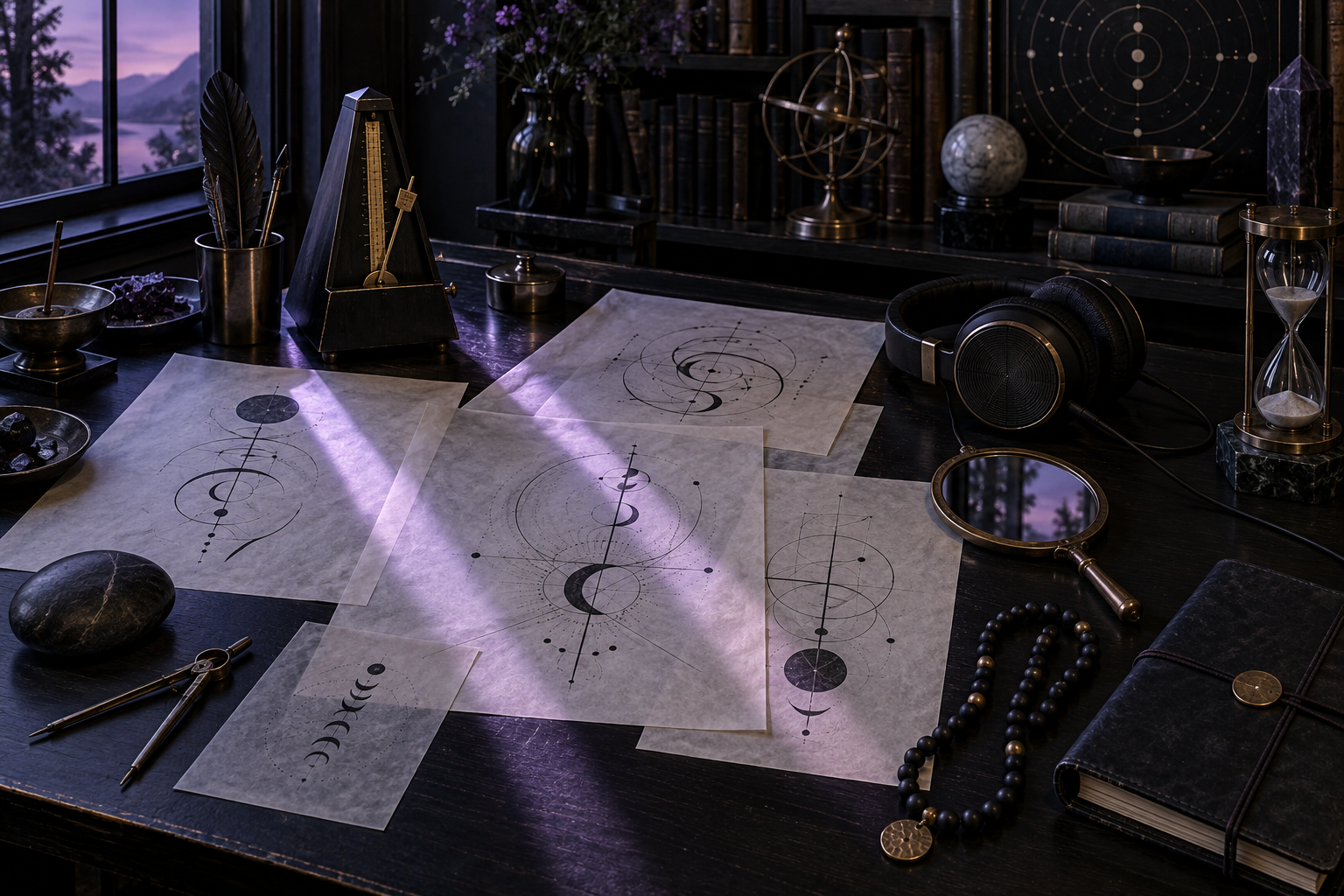
The drummer misses a beat, and for one impossible second the whole room seems to enter the gap. The sigil on the wall is no longer a drawing being inspected. It is the only thing that has edges. Then ordinary awareness floods back: heat, breath, an aching calf, someone coughing near the door. The mark has not revealed a secret doctrine. Attention has changed its shape around it.
Gnosis in chaos magic names a focused or altered state used to interrupt ordinary discursive thought during magical action. It does not usually mean possession of hidden spiritual knowledge, and it should not be casually collapsed into ancient Gnosticism, the diverse religious movements and texts concerned with divine origin, revelation, salvation, and the soul’s condition in the cosmos.
Chaos-magical gnosis is better understood as an operation on attention. By narrowing, saturating, exhausting, startling, or suspending the usual commentary of the mind, it changes how an intention is experienced at a decisive ritual moment. The state is not the spell’s prize. It is the weather through which the act becomes unusually singular.
01 / ONE WORD, DIFFERENT WORLDS
Chaos-magical gnosis is not shorthand for Gnosticism
The Greek word gnōsis means knowledge, but historical religious usage gives it far more weight than ordinary information. Texts found at Nag Hammadi and writings discussed by early Christian heresiologists preserve multiple cosmologies, myths, and revelatory arguments rather than one uniform “Gnostic religion.” In those settings, knowledge can concern divine reality, human origin, cosmic rulers, and liberation.
Chaos magic repurposes the word. In influential late twentieth-century accounts, gnosis describes states in which ordinary mental noise, self-observation, and competing desire fall away enough for a magical intention or sigil to dominate awareness. The borrowing creates grandeur, but the operative meaning is closer to attentional extremity than a revealed map of the divine world.
This distinction prevents two errors. The first is claiming ancient religious authority for a modern magical technique. The second is treating every moment of concentration as mystical salvation. A person may enter an absorbed state while dancing, gaming, running, making music, or solving a problem. Chaos magic makes such changes of consciousness ritually purposeful; it does not own them.
Recovery of knowledge is a different operation from altering attention. The Forbidden Truth Returned restores a forbidden truth to every mind from which it was erased; work that return when information itself has been removed. Its power shows exactly what chaos-magical gnosis is not.
02 / THE ATTENTIONAL GATE
The ritual changes when commentary loses the center
Ordinary attention is crowded. A practitioner gazes at a sigil while also evaluating posture, remembering an email, anticipating results, and wondering whether the operation is “working.” These parallel processes keep the magical act inside familiar self-monitoring. Gnosis aims at a discontinuity: for a brief interval, the evaluating narrator ceases to be the loudest presence.
That does not require unconsciousness. In fact, complete loss of awareness would make it difficult to say that an intention occupied the decisive moment. The useful state is often a paradox: reduced commentary with heightened immediacy. The sigil, sound, phrase, sensation, or gesture becomes vivid while the usual biographical chatter recedes.
The state changes ritual in at least three ways. First, it changes salience: one element commands the field. Second, it changes encoding: an image encountered under unusual arousal or stillness may be remembered differently from one glanced at casually. Third, it changes authorship: an intention can feel less like a sentence the everyday self is trying to force and more like an event that has already occurred.
None of these effects proves a supernatural mechanism. Nor does a cognitive description disprove magical value. Chaos magic has often been willing to hold several models provisionally—spirit, energy, psychology, information—and ask what each permits the practitioner to notice. The disciplined move is to avoid turning a compelling state into evidence for every explanation at once.
03 / TWO ROADS TO THE GAP
Inhibitory and excitatory gnosis alter the field in opposite directions
Chaos-magical literature commonly distinguishes inhibitory from excitatory approaches. Inhibitory gnosis moves toward stillness, attenuation, and the reduction of stimuli. Excitatory gnosis moves through increasing intensity, rhythm, emotion, exertion, or sensory saturation until thought is crowded out. One empties the room; the other fills it so completely that only one door remains visible.
The distinction concerns trajectory, not spiritual rank. Quiet does not automatically produce depth, and intensity does not automatically produce power. A practitioner can sit motionless while rehearsing grocery lists; another can reach fierce absorption during percussion while retaining exact awareness of the ritual aim. Conversely, fatigue, panic, pain, breath deprivation, or intoxication can reduce judgment without producing useful focus. Impairment is not a credential.
| Attentional mode | What changes | What can be mistaken for success |
|---|---|---|
| Inhibitory | Competing stimuli and inner speech diminish | Drowsiness, numbness, or passive waiting |
| Excitatory | Intensity saturates awareness around one act | Overwhelm, performance, or loss of judgment |
| Absorptive | The object becomes intrinsically compelling | Aesthetic fascination without a defined magical aim |
| Interruptive | A sudden break suspends the ongoing mental sequence | Mere surprise with no relation to the rite |
The measure is not how dramatic the state looks from outside, but whether attention became singular without destroying the capacity to return and judge.
CASE FILE THE GALLERY WALL
The same sigil enters three different kinds of attention
Rafi designs a mark for the courage to submit a difficult installation proposal. He encounters it in three ritual settings and records not “power,” but what attention actually did.
In silence, the mark sharpens but self-criticism keeps speaking. During a loud group rite, rhythm erases the criticism, yet the group’s excitement makes the aim feel grander than it is. Days later, while adjusting the final model, absorption arrives without spectacle: the mark and the practical next action become one intelligible shape.
Stillness
The object is clear; the judging narrator remains active.
Saturation
Commentary vanishes; borrowed group certainty rushes in.
Absorption
Attention narrows while practical judgment stays available.
Return
The proposal is edited and sent, not merely felt as destined.
READING THE STATE
The loudest rite produces the strongest sensation, but not the cleanest relation to the aim. The quiet session reveals resistance without crossing it. The absorbed design session changes the ritual because image, desire, and executable action briefly stop competing.
04 / THE SIGIL MOMENT
Gnosis does not charge a mark like a battery
The popular phrase “charge the sigil” suggests a device accumulating an invisible quantity. That metaphor can be useful, but it can obscure what is experientially happening. Under gnosis, the mark may become the sole carrier of a desire that has been stripped of explanatory prose. Instead of repeatedly arguing for the outcome, the practitioner encounters a compressed form at a moment when counterargument has weakened.
Forgetfulness is often attached to this model. The point is not necessarily literal amnesia, which can become a theatrical and impossible demand. It is release from compulsive checking. An intention continuously inspected—Has it worked? Is that a sign? Should I repeat it?—keeps returning to the ordinary mind as an unresolved problem. Letting the operation recede changes the relationship from surveillance to consequence.
But forgetting cannot repair a vague aim. If the sigil compresses contradiction, gnosis may intensify the contradiction rather than solve it. “I want total freedom and universal approval” contains two authorities. “I receive the job at any cost” makes cost invisible at precisely the moment attention narrows. Altered focus magnifies design; it does not replace it.
If the difficulty is a broken train of thought rather than ritual absorption, Recall the Wandering Mind restores a target’s concentration. Cast it for that interrupted cognitive function, not for the deliberately unusual threshold of focus that chaos magic calls gnosis.
05 / WHO OWNS THE PEAK?
Group gnosis can synchronize attention—and lend authority to the room
Rhythm, chant, synchronized movement, and shared silence can align participants with unusual speed. A group may experience one decisive pause as charged because everyone reaches it together. This is a real social effect whether interpreted magically, psychologically, or both: timing becomes communal, witness multiplies, and private hesitation may temporarily fall beneath collective momentum.
The same force complicates consent. A participant may continue because stopping would break the atmosphere. A leader who controls rhythm, duration, interpretation, and the moment of release controls more than aesthetics. Afterwards, the group may treat intensity as proof that the leader’s explanation is correct. Yet synchronized attention demonstrates synchronization, not the exclusive truth of the person at the center.
This is why return matters. A sound group can tolerate the participant who says the peak felt empty, frightening, distracting, or simply different. If every report must confirm success, gnosis becomes a loyalty test. An altered state should open inquiry, not close jurisdiction over what everyone experienced.
06 / THE RETURNING MIND
The aftermath tells more than the climax
A dramatic state is easy to fetishize because it supplies immediate evidence that something happened. Results are slower and less obedient. Did the intention become clearer? Did action follow? Did the rite expose a contradiction? Did the practitioner become more capable of meeting ordinary life, or merely more dependent on repeating the peak?
Integration is not a lesser phase outside magic. It is where interpretations compete with records and consequences. The practitioner who can describe the state without inflating it preserves both wonder and discrimination: “My inner speech stopped for several seconds; the image felt complete; afterward I sent the proposal.” This is more useful than declaring contact with ultimate truth because the room briefly vanished.
Chaos magic’s enduring provocation is that belief and technique may be handled experimentally rather than enthroned permanently. Gnosis intensifies that experiment. It lets a chosen frame occupy consciousness with extraordinary force. The discipline lies in remembering, afterward, that force of occupation and truth of explanation are not identical.