THE EVIL EYE · NAZAR · ENVY AND DEFENSE
Evil Eye Protection: What the Nazar Sees—and Turns Away
The blue glass eye is not simply a pretty charm. It answers a dangerous question: when admiration carries a hidden wish to take, what meets that gaze first?

STAR & SIGIL
Name the gaze, then close its road
Protection sharpens when the source and boundary are specific. Preview a cataloged working without mistaking it for any traditional nazar rite.
Open the targeted protection working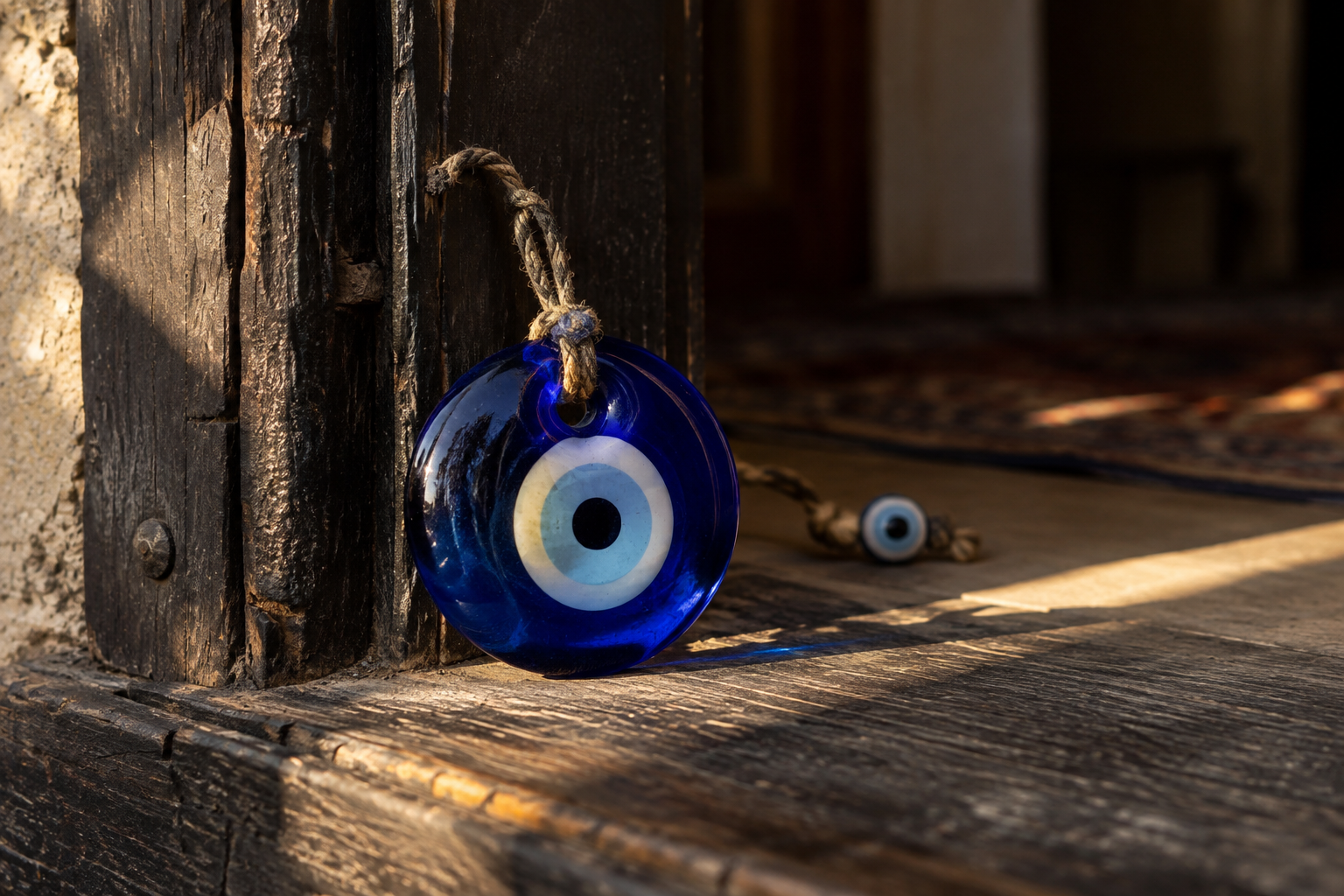
A blue glass eye hangs over a doorway. Everyone passing under it can see the charm. The harder thing to see is the moment it was made for: a glance that begins as admiration and ends as possession. Someone praises a child, a new home, a thriving shop. Beneath the compliment sits the unspoken wish that the good fortune belonged elsewhere. The amulet meets that wish before its owner has to name an enemy.
This is the power and the trouble of the evil eye. It is not simply a curse cast with a stare, nor a universal diagnosis for an unlucky week. In many living traditions, a harmful gaze can arise through envy, attention, praise, or an imbalance between what is displayed and what another person longs to have. The danger is relational. The gaze needs something worth looking at and an ache in the person looking.
Evil-eye protection asks where unwanted attention goes. An amulet may meet it, divert it, receive it, or declare that a cherished thing will not be consumed by being seen. Those verbs matter more than the photographable blue disc. Once you know the action, the little eye becomes less like a souvenir and more like a guardian posted between delight and hunger.
01 / THE GAZE
What is the evil eye actually supposed to do?
The phrase names a family of beliefs, not one doctrine owned by one culture. Across different communities around the Mediterranean, the Middle East, and beyond, people have understood a charged gaze as capable of troubling a person, animal, household, or undertaking. The details vary. One account fears deliberate malice; another is more unsettled by envy that acts almost involuntarily. The same social scene can hold affection and danger at once: a proud announcement invites joy, yet also exposes the thing announced.
That ambiguity explains why evil-eye protection often belongs to vulnerable or newly fortunate subjects: infants, animals, a fresh business, a hard-won success. The subject is not assumed to be weak. It is conspicuous at a moment of change. The concern is that being admired has created a path by which a stranger’s lack can reach it.
Notice the difference from a formal hex. A hex is usually described as an act directed toward a target. The evil eye may be imagined as more fleeting, less explicit, even unwanted by the person whose glance carries it. To collapse both into “negative energy” is to erase the sharp human insight at the belief’s center. A compliment can be sincere; it can also be possessive. A protective practice lives in that uneasy interval, where neither accusation nor naivety is adequate.
The expert’s distinction
An amulet guards the cherished thing from a charged look. It does not prove that everyone who admires the thing wishes it harm.
02 / THE BLUE GLASS EYE
The nazar is a defender, not a confession of fear
The familiar concentric blue-and-white glass eye is especially associated with Turkish protective practice, though eye amulets and related defenses have many regional forms and histories. In an ordinary room it may be modest: a bead on a pin, a hanging disc by the entrance, an ornament on an animal’s gear. It is easy to photograph and therefore easy to detach from the life that made it meaningful. Yet the object’s placement is part of its grammar. Near the door it meets arrival; on a person it travels with a body; on an animal it guards a living source of livelihood and affection.
A bellwether amulet preserved in the British Museum makes that last point vivid. Its blue glass beads accompany a bell, embroidered triangles, tassels, cord, and leather on a sheep leading a flock. This is not a solitary cobalt icon floating in a product photograph. It belongs to motion, sound, work, and an animal watched by other people. The blue eye participates in a protective arrangement rather than replacing the whole world around it.
Nor should every blue protective eye be flattened into the same tradition. The ancient Egyptian wedjat eye has its own mythic body and visual form; it is not an antique nazar. A modern eye sticker, a family heirloom, a shrine souvenir, and an amulet made for a working animal do not carry identical histories simply because a lens catches blue glass. For a witch studying amulets, this difference is useful rather than restrictive. It shows how an object becomes powerful through its social placement as well as its shape.
When the concern is a specific project drawing jealous attention, a modern spell can take a different route from the nazar without pretending to be the same rite. The Mirror-Thorn Seal turns jealous attention away from your work and veils its brilliance from spite. A creator can perform the spell while the work still needs room to become itself, before every watcher gets a claim on it. The distinction is deliberate: the living eye amulet meets a gaze; this working protects the space around something still being made.
03 / FIVE ANSWERS TO A LOOK
Protection is not always a shield
The same troubling gaze can be answered in different ways. Each answer changes the relationship between visibility and power.
| Protective logic | What it claims | What it risks forgetting |
|---|---|---|
| Meet | A visible eye or sign receives the first force of the glance. | The wearer still lives among people and cannot outsource all discernment. |
| Divert | Attention turns from the vulnerable subject toward a decoy or edge. | What is displaced needs somewhere to go. |
| Conceal | The prized thing is withheld until it can bear being seen. | Endless hiding can shrink the life being protected. |
| Transform | The force of envy becomes material for growth rather than damage. | Not every admirer is an adversary or a source to harvest. |
| Disarm | The jealous relationship itself changes, and the eye loses its charge. | An amulet cannot substitute for an honest conversation when one is possible. |
The last answer is the least theatrical and often the most surprising. If envy arises between friends, protection may mean preserving the friendship rather than building a wall against one person’s eyes. The wrong spell makes the friend into a permanent danger. The right question asks whether admiration has become comparison, whether an old intimacy feels threatened by new success, and whether the people involved can still speak to each other.
Evil-eye discernment should never become a list of people to suspect. Friends can envy friends and still love them. Friendship Without the Green Eye addresses that intimate fracture by preventing the target from becoming jealous of their closest friend. Perform it where comparison is wounding a valued bond: protection then begins at the source of the jealousy instead of turning the admired friend into a permanent suspect.
CASE FILE THE SHOP WINDOW
When every compliment became evidence
A maker opens a small shop. The week after its launch goes badly, and the blue eye over the door begins to feel less like a guardian than an accusation.
Leila hangs an eye amulet beside the entrance on opening day. The first visitors praise the ceramic bowls displayed in the window. A former colleague compliments the space, then launches a similar range online. On Tuesday the card reader fails; on Friday a glaze batch comes out wrong. By Sunday, Leila believes the colleague has looked at the shop with envy. She moves the amulet to face their photograph and stops speaking to a friend who liked the competing work.
A real social tension
The colleague’s imitation may hurt. It does not make every compliment an act of magic.
Two ordinary causes
A payment outage and a glaze failure need their own explanations before becoming one supernatural pattern.
Its office has shifted
A defender at the doorway has become a pointer aimed at one person’s image.
Welcome is closing
Leila is losing the friends, buyers, and pleasure the shop was opened to receive.
THE READING
The amulet makes most sense when it protects the shop’s threshold of welcome, not when it serves as a verdict on the colleague’s soul. Leila can address copying as a business matter, repair the card reader, test the glaze, and decide what work she wants public before its next launch. None of that requires her to renounce the eye over the door. It requires her to let the charm guard the shop rather than appoint it judge of everyone who admires the shelves.
04 / THE BREAK AND THE STORY
What does a broken evil-eye amulet mean?
The broken blue disc is one of the belief’s most seductive images. In some telling, it has taken the force meant for its wearer. That reading can be emotionally exact: the protector bears a mark so the cherished thing does not have to. But glass also breaks because it is glass. Cord frays. A bead swings against a hard door. Neither explanation need cancel the other as a personal interpretation; trouble begins when the break is treated as proof that a named person has attacked.
An amulet is most useful when it can be retired without escalating the story. The wearer may honor what it represented, notice the ordinary cause of breakage if one is evident, and choose whether to replace it. The crucial expert move is to keep the sign at the level it can bear. A cracked object can mark the end of one protective season. It cannot, by itself, identify a hostile eye in a crowded room.
The same discipline applies to the popular claim that blue itself is the whole magic. Color matters in particular traditions, but no single shade makes every eye symbol equivalent. The object’s materials, making, placement, use, and community of meaning are part of its force. A mass-produced disc bought as decor and a bead carried through family practice can look alike in a photograph while inhabiting very different lives.
05 / A LIVING CHARM
The eye does not live only in museums or shopping carts
To an outside collector, an eye amulet is a motif to categorize. To a wearer, it may be a grandmother’s gift, a marker of home, a gesture of affection for a child, or a quiet assurance at a business entrance. Its meanings are not frozen in an antique display. Modern manufacture does not automatically make every amulet meaningless; older material does not automatically make one authoritative. The relationship around the object matters.
That is also why the nazar should not be introduced as a universal “witchcraft symbol.” Witches may study and use protective eyes, but the blue glass form belongs to living histories beyond the English-language occult marketplace. A respectful description keeps the source culture visible without pretending that one can buy a whole tradition with one pendant. It also resists the opposite error: making ordinary people’s everyday defenses so untouchable that they disappear behind museum glass.
What remains for a witch who wants to learn from the eye? Not a borrowed claim of lineage. A precise observation: some harms are imagined to arrive as attention, and some protections answer by making attention visible. A protective object can defend the joy of being seen without requiring the world to stop looking.
The glass eye at the doorway
At day’s end the blue disc catches the last light. The people who passed beneath it have gone home. Some praised what they saw; some were indifferent; one may have wished, briefly and fiercely, to possess it. The amulet cannot tell you which was which. That uncertainty is not its failure. It is the reason the symbol exists.
An eye can remain open at the threshold without forcing its wearer to live in suspicion. The work of protection is to keep the cherished thing intact—and to keep enough trust intact that it remains worth cherishing.