FLAME · PASSAGE · UNFINISHED WAX
Candle Tunneling Meaning: The Flame, the Wax Wall, and the Hidden Path
A tunneling candle travels downward through its own body while a wall of unused wax rises around the flame. The image is potent—but its meaning changes according to what the ritual expected the light to reach.

STAR & SIGIL
Leave the wax wall intact long enough to learn
A tunnel can question fragmented attention without demanding a dangerous rescue or a supernatural verdict.
Open the melt-pool inquest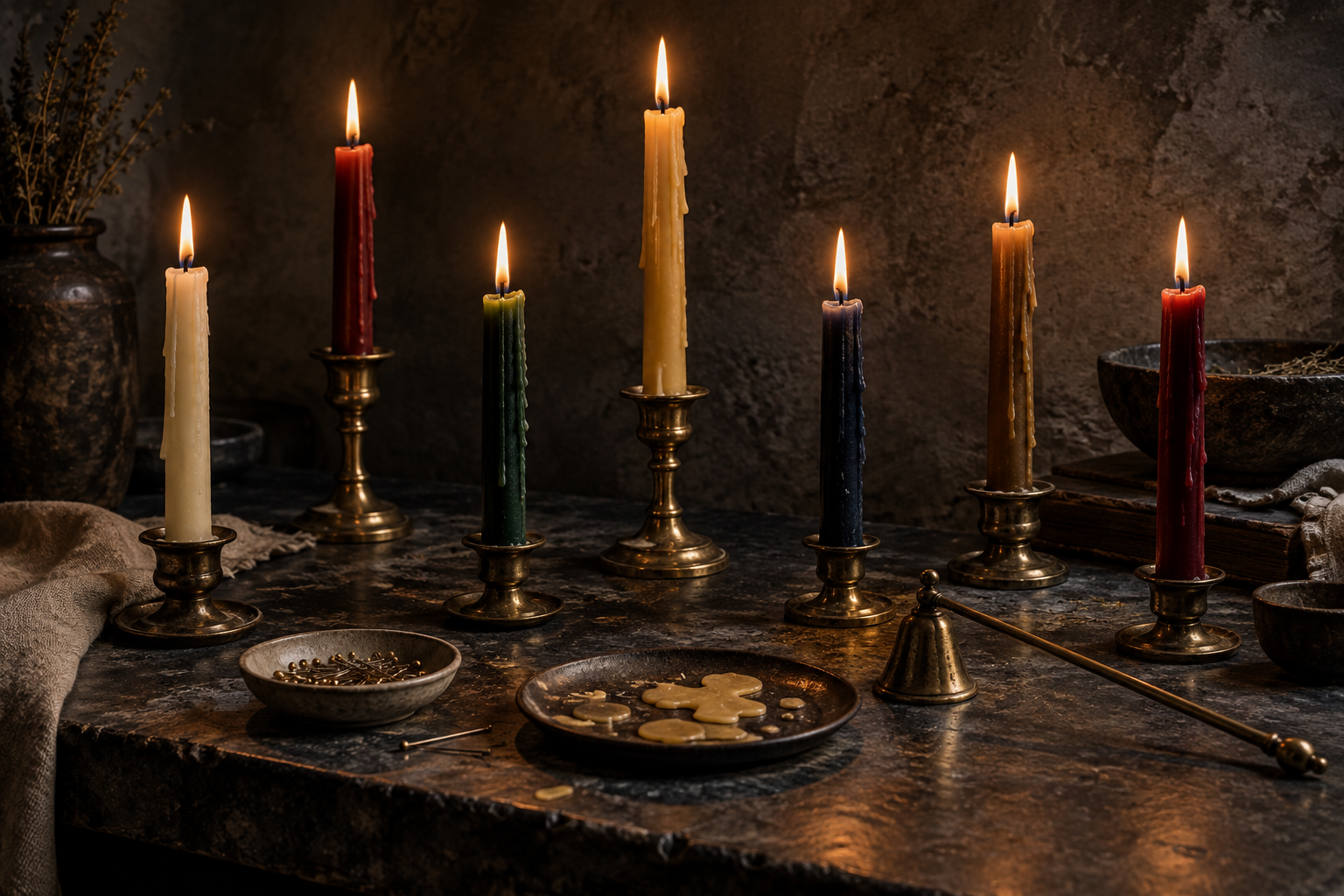
The memorial candle burns for sixteen hours without lighting the brass key suspended in its outer wax. Instead, the flame descends into a narrow well. By midnight, a pale wall surrounds it like a tower, and the key remains visible but untouched three fingers beyond the glow.
The Vale siblings had agreed that whichever key the wax released would name the keeper of their mother’s locked studio. Now the candle has released nothing. Mara calls the tunnel a refusal. Jo calls it protection. Silas, who commissioned the candle, says their mother has chosen secrecy. None mentions that he ordered a wick too small for the vessel.
Candle tunneling occurs when the central wax melts and burns while a substantial rim remains. Wick size, wax, vessel, heat, airflow, and the candle’s earlier burn history all shape the result. Those mechanics do not make occult interpretation foolish. They identify the material event the ritual is interpreting: a flame able to move downward but unable to transform the full field around it.
01 / THE NARROW HEAT
The candle is not burning inward; its heat is failing to travel outward
A candle works by drawing melted wax through the wick, vaporizing it, and burning that vapor in the flame. The heat also creates a melt pool around the wick. When that pool remains narrower than the candle body or vessel, the center is consumed while cooler wax at the edge survives.
A wick poorly matched to the candle’s diameter may not produce enough heat to liquefy the outer field. Dense or high-melting wax, a cool environment, short burn periods, drafts, additives, and an established narrow burn channel can reinforce the pattern. The result has a distinctive architecture: descending light, enclosing wall, unused fuel.
That architecture matters more than declaring tunneling simply positive or negative. The flame is active. The candle is not inert or extinguished. But transformation is concentrated along one path, leaving material beside it unavailable. Physically, this is uneven heat distribution. Ritually, it can image focus, isolation, obstruction, preservation, secrecy, or a goal reached by sacrificing breadth.
02 / READ THE ARCHITECTURE
The surviving wall changes meaning with the ritual verb
Begin with what the candle was meant to do. The same tunnel can fulfill one operation and frustrate another.
| Ritual aim | What the tunnel can image | The decisive question |
|---|---|---|
| Penetration | A force cutting through resistance by one concentrated route. | Did the narrow path reach the intended depth? |
| Illumination | Insight isolated inside a private chamber. | What remained outside the light? |
| Release | The core moving while surrounding attachments remain fixed. | Was the burden meant to leave whole? |
| Protection | A wall preserving the flame from the outer field. | Is the enclosure shelter or confinement? |
| Completion | Duration consumed without the entire material answering. | What condition defined “finished” before the burn began? |
03 / THE CANDLE REMEMBERS ITS CONDITIONS
Burn history can masquerade as destiny
A candle’s current shape contains its earlier use. Once a central channel forms, later heat tends to follow the established hollow. What appears during the decisive ritual may therefore record an earlier short burn, a cool room, or a manufacturing mismatch rather than a new resistance arriving at the dramatic moment.
This gives tunneling an especially strong relationship to memory. The candle body remembers through form. Its future options are narrowed by wax that melted and hardened before the reader began watching. Ritual interpretation should ask not only what the flame is doing now, but what prior conditions taught it to burn this way.
The Vale memorial candle carries two histories. Its wax bears the siblings’ shared intention, but its proportions bear Silas’s private commission. When it tunnels, those histories collide. The flame does not independently rule on inheritance. It reveals that the object assigned to judge ownership arrived with a material bias.
04 / ACCESS IS NOT OWNERSHIP
A tunnel may reach the chamber without settling who belongs there
Passage magic often acquires the glamour of entitlement. If someone can open the lock, find the hidden corridor, or reach the center, the success itself seems to prove a right to what lies beyond. But skill, permission, custody, and ownership are different relations.
The siblings’ candle was asked to release a key and thereby declare a keeper. This gives combustion legal authority it cannot explain. Even if the wax had freed one key cleanly, the event would not reveal who maintained the studio, who understood the work, or what their mother intended. The rite compresses a complicated inheritance into access.
At the far edge of that logic stands a working in which the lock itself recognizes rightful possession. The Lock That Calls You Owner asks the lock itself to recognize rightful custody; cast it to make a sealed treasury open because its locks remember you as its rightful owner. Its precision exposes what the memorial candle lacks: not merely an opening, but a supernatural claim that the mechanism knows whose authority deserves it.
CASE FILE THE KEY OUTSIDE THE LIGHT
Three heirs and a candle commissioned to judge them
The ritual’s failure to release a key reveals the hidden hand that shaped its possible verdicts.
The Vale siblings suspend three small brass keys at equal intervals inside a broad memorial candle. The key released first is meant to name the keeper of their late mother’s studio. Silas arranges the commission alone. During the vigil, a deep central tunnel forms without reaching any key. He interprets the intact wall as their mother’s refusal to choose.
Wick
The undersized wick concentrates heat at the center and makes broad melting unlikely from the start.
Wall
The surviving wax looks protective, but it also prevents the rite from reaching its declared outcome.
Keys
Equal placement creates visual fairness while the candle’s central mechanics make every release improbable.
Commission
Silas controls the object, then treats its built-in limitation as their mother’s posthumous will.
THE VERDICT
The tunnel is physically unsurprising and ritually revealing. It does not name an heir; it shows that the judging instrument was incapable of delivering its promised decision. The unburned wax becomes an image of inheritance protected from scrutiny by a process designed to remain inconclusive.
06 / THE TUNNEL TEST
A strong reading can be changed by an inconvenient fact
Begin with the ritual verb. Was the candle meant to spread, release, reveal, protect, consume, or penetrate? Then identify the material pattern: narrow melt pool, surviving wall, flame behavior, timing, and prior burn history. Only then ask what symbolic relation connects the two.
This order prevents the favorite interpretation from swallowing the candle. “Resistance” should not be the automatic answer whenever wax remains. “Protection” should not rescue every disappointing result. “Focus” should not excuse a working whose stated aim required broad transformation.
For the Vale siblings, the decisive detail is not the tunnel itself but the mismatch between the candle’s capacity and the rite’s promise. A process claiming to select among keys was materially arranged not to reach them. That fact changes the spiritual reading from ancestral silence to manipulated ambiguity.
Candle tunneling becomes meaningful where mechanics and metaphor touch. The wick carries fuel through one channel; the ritual carries intention through another. When both travel downward while the surrounding material remains unchanged, the reader must decide whether they are witnessing disciplined passage—or a light that has mistaken depth for completion.
Read the wall as carefully as the flame
Name what the light reached, what remained untransformed, whether that remainder was intentional, and who benefits from calling the result complete.
The keys after the vigil
The siblings cut the unburned wax open in daylight and recover all three keys together. No key has been chosen by flame. The tunnel remains through the candle’s heart, a record not of their mother’s refusal but of the narrow method they allowed to govern a broad inheritance.
That is candle tunneling meaning at its clearest: the flame found a way through, but passage alone did not transform the whole field. The interpretation begins with whatever the light left standing.