BEAUTY · GLAMOUR · THE GAZE
Beauty Spells: Glamour, Gaze, and the Chosen Image
A beauty spell does not discover a final truth in the mirror. It composes an encounter: what advances, who is invited to look, which desire awakens, and when the image may be taken apart.

STAR & SIGIL
Choose exactly how the glamour opens
Carry adornment into a working where visibility has an aperture, every surface has an office, and removal is part of the art.
Open the seven-surface glamour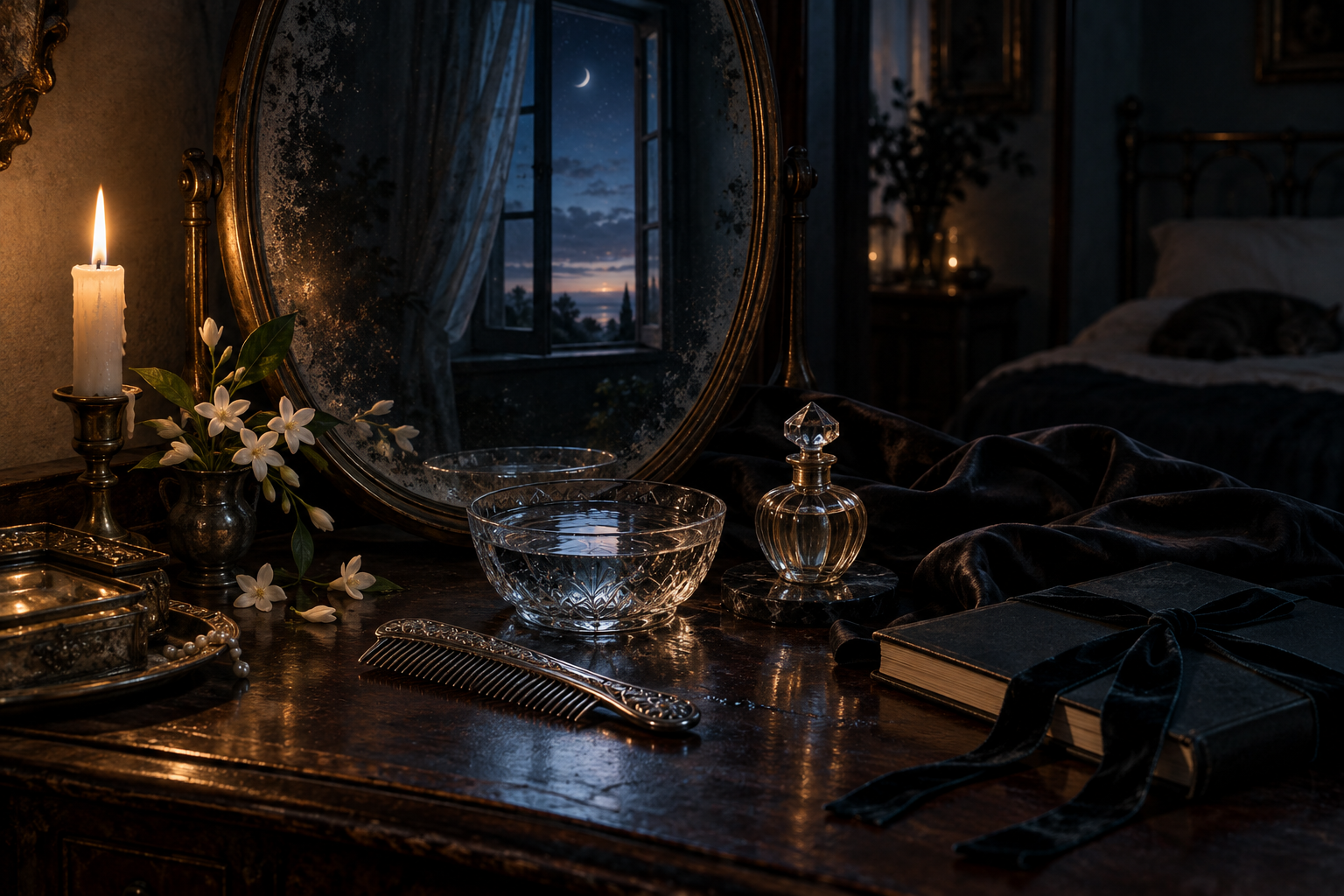
A beauty spell does not have to correct a body. It can compose a surface, heighten a chosen quality, or decide how a person will meet the gaze waiting beyond the mirror. Its medium is not flesh alone. Color, pace, fabric, scent, voice, light, memory, expectation, and the observer’s desire all participate in what becomes beautiful.
This makes glamour a form of selective revelation. Something advances; something recedes. The magical question is not whether the resulting image is the practitioner’s one true self. It is who authored the selection, what kind of attention it invites, and whether the wearer can remove it without feeling that beauty has been revoked.
01 / THE GLAMOUR’S OFFICE
Glamour is an arrangement of emphasis
Every presentation edits. A black line makes one edge legible; a high collar changes the architecture of the neck; a deliberate pause gives the mouth another gravity. Even an apparently bare face is read through lighting, expression, context, and expectation. Glamour makes that editing conscious and ritualized.
The operation can reveal rather than disguise. A person whose exuberance is routinely softened may use saturated color to let it arrive first. Someone entering a formal office may lend their meticulousness a visible shape. Another practitioner may choose veiling, making privacy—not exposure—the beautiful quality. The spell does not owe every witness the same image.
Because emphasis is not totality, a glamour remains partial. It can be sincere without being exhaustive. Trouble begins when the selected quality claims to explain the entire person or when the wearer becomes unable to exist outside the arrangement without feeling counterfeit.
03 / BEAUTY AND DESIRE
To be beautiful is not to become available
Beauty magic is often narrated as attraction magic in disguise. The practitioner becomes radiant so that another person will approach, choose, buy, approve, or desire. Yet beauty can serve celebration, mourning, artifice, rank, play, devotion, camouflage, or private sensory pleasure. Desire may awaken around it without becoming its purpose.
The distinction matters because a gaze tends to tell stories about what it sees. An observer may read red as invitation, severity as cruelty, softness as compliance, or ornament as a request for comment. Glamour can influence these readings but cannot guarantee them, and the wearer’s agency is not transferred by being noticed.
Sometimes the necessary magic is not stronger allure but a return of interpretive ownership. See the Heart Beneath Glamour cuts through the image laid over the heart: Let someone see their own true feelings through any glamour placed over them. A witness can perform this spell when a persuasive image has made admiration, identification, envy, and desire difficult to distinguish.
04 / THE CHOSEN IMAGE
An adornment can be true without being permanent
Ritual dress is sometimes defended as the revelation of an authentic hidden self. That can be powerful, but permanence is not required for truth. A silver mouth worn for one performance may be true to the performer’s ferocity that night. A severe braid may give concentration a form for one negotiation. A veil may express an honest wish not to be visually consumed.
Temporary forms protect beauty from becoming another compulsory identity. The practitioner can ask: What quality is being advanced? For whom? For how long? What ends the image? Removal then belongs to the art instead of signifying collapse. The face after adornment is not a failed version of the face before it.
This also changes the mirror’s office. Rather than issuing a verdict, the mirror becomes a rehearsal witness. It can show whether the chosen line, color, or gesture carries the intended emphasis. Once that question is answered, the practitioner may turn away. The reflection need not keep voting.
HYPOTHETICAL CASE THE SILVER MOUTH
Suppose Mireya paints her mouth silver for a midnight performance
This invented scene follows beauty as composition, misreading, and chosen removal.
Mireya designs sound for an experimental theater piece. She appears briefly onstage to ring seven metal bowls and chooses a silver lip color that makes her mouth echo their surfaces. In rehearsal the image feels exact: voice, metal, and reflected light become one instrument. After a photograph circulates, strangers call the look seductive and ask where she will wear it next.
Surface
The color makes the mouth part of the sonic machinery.
Meaning
Beauty arises from relation, not from correcting her face.
Detached gaze
A still image removes the performance that explained the choice.
Agency
Removing the silver ends the composition without repudiating it.
READ THE IMAGE IN TIME
The strangers are not wrong to find the image alluring; they are wrong if they make allure its only office or treat it as a standing invitation. Mireya’s spell succeeded before their response: the mouth entered the instrument she designed. Her decision to wipe it clean after the final bowl is the glamour’s proper ending, not beauty disappearing.
05 / THE BEAUTIFUL FLAW
Perfection can destroy the information attraction needs
Glamour becomes coercive when it does not merely select but falsifies every limiting fact. A voice is made warm enough to conceal contempt; polish disguises the demand behind generosity; an immaculate image prevents the witness from seeing ordinary inconsistency. Here beauty stops being composition and becomes an argument that no contrary evidence may enter.
Flaws are not automatically noble, and exposure is not always owed. Their magical importance is informational. In intimacy or consequential choice, another person needs enough reality to decide what the beauty means in company with limitation. A surface may enchant without claiming that enchantment is the whole record.
When perfection has swallowed that record, perform Restore the Flaws Behind the Glamour to Restore the ordinary flaws that an attraction glamour concealed from a chosen person. The working fits the moment when desire needs proportion returned, allowing allure and ordinary limitation to remain visible at once.
06 / THE POLITICS OF LOOKING
Not every gaze deserves more access
A beauty spell can intensify visibility, but increased visibility is not an uncomplicated prize. Attention may bring opportunity, pleasure, recognition, imitation, surveillance, resentment, or claims of ownership. The sophisticated glamour therefore includes an aperture: who is invited, at what distance, under which conditions, and what remains unseen.
Veiling is not beauty’s opposite. A hood can frame the face while withholding the hair. A severe silhouette can make presence unmistakable while refusing softness. A private adornment can make the body feel ceremonially vivid without supplying any public image. Beauty magic includes the right to choose a narrow audience—or no audience at all.
The gaze also has duration. A photograph may outlive the context in which an image was freely offered; a remembered appearance may become a demand that the wearer reproduce it. Agency requires the power to declare the composition ended even when witnesses would prefer an encore.
07 / DISMANTLING THE GLAMOUR
Removal proves that the wearer still authors the image
A complete beauty enchantment includes its unmaking. Pins come out, pigment lifts, scent fades, ceremonial fabric is folded, and the mirror returns to ordinary service. This ending distinguishes adornment from captivity. The practitioner is not required to preserve the successful image until it becomes labor.
Dismantling also reveals what the spell changed. Perhaps a color now carries a memory of daring. Perhaps a gesture remains available without the costume. Perhaps the practitioner discovers that the pleasure belonged entirely to preparation, not public reception. These are not lesser outcomes than universal admiration; they are more exact records of where the enchantment lived.
The chosen image can be repeated, revised, or allowed to remain singular. Its beauty does not depend on becoming a brand or an improved permanent self. Glamour retains its mystery when it can arrive fully, alter the field of attention, and then depart without leaving the wearer in debt to the gaze.