BEAUTY · GLAMOUR · MATERIAL TRANSFORMATION
Beauty Spell Ingredients: What Mirrors, Petals, Honey, Shells, Color, and Perfume Change
A mirror does not do what honey does. A shell cannot replace a petition. Beauty magic becomes intelligible when each material changes a different relation among body, self-image, atmosphere, attention, and the freedom to see clearly.

STAR & SIGIL
Give every surface a way to shine
Continue into a glamour working that assigns mirror, scent, sweetness, and name their exact offices in the enchanted image.
Assemble the glamour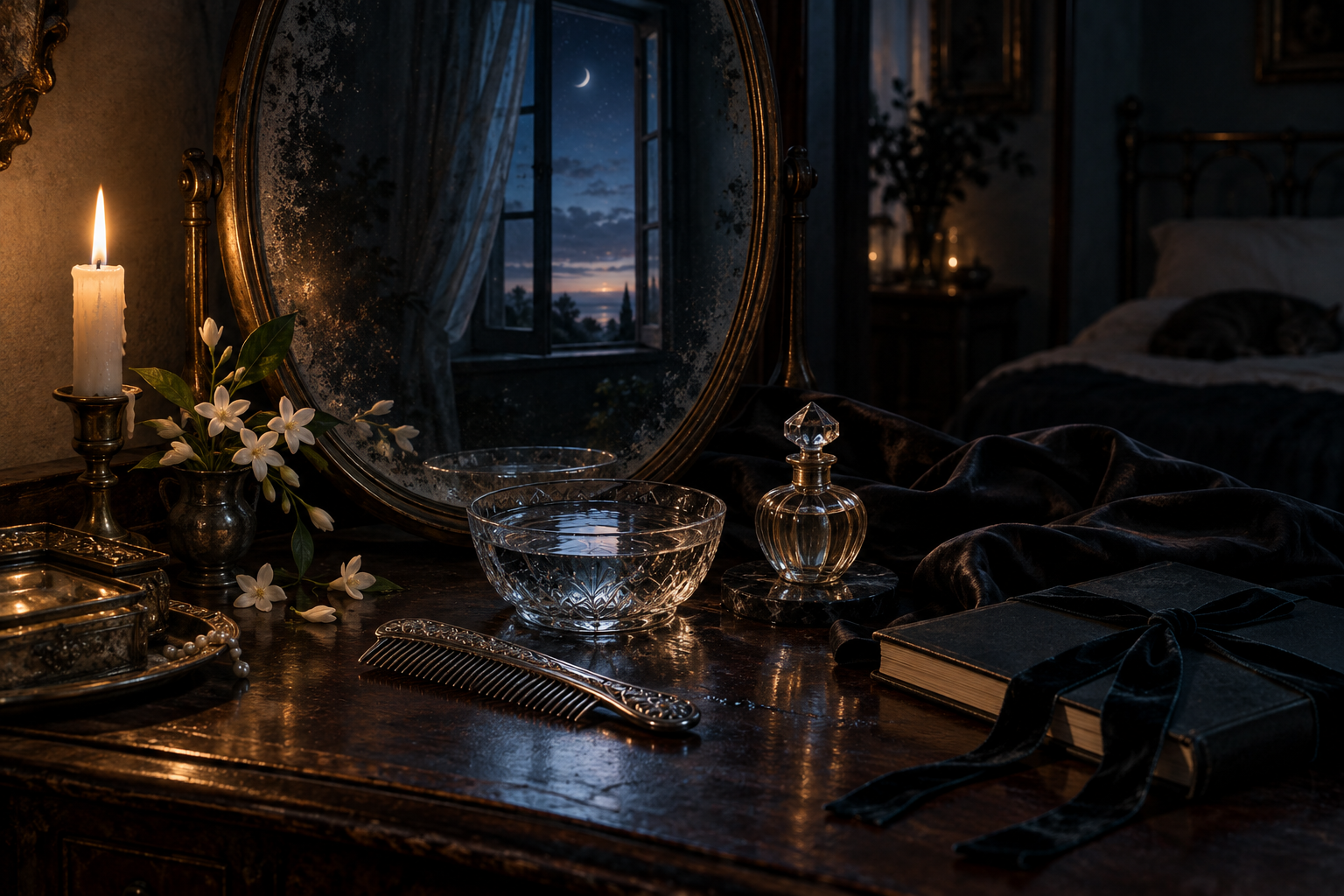
Beauty spell ingredients do not form a basket of interchangeable prettiness. A mirror changes the relation between image and witness. Petals give beauty a living tense that can open, bruise, fade, and return. Honey alters the quality of regard. Shells establish an interior worth protecting. Color creates an atmosphere before a face is read. Perfume crosses distance as presence. A petition tells all of them whose beauty is changing—and what must remain free.
The real craft lies in choosing the transformation before choosing the object. “Make me beautiful” can mean restore strength, make existing skill visible, soften self-regard, draw appreciative attention, conceal a feature, command desire, or defend radiance from envy. Those are different workings with different consequences.
A fascinating beauty spell is not the one with the longest ingredient list. It is the one in which every material can explain its exact verb.
01 / MIRROR
Reflection appoints a witness—and may become a judge
A mirror can confirm, multiply, reverse, reveal, or rehearse. In beauty work, its first question is not “What do I look like?” but “Whose seeing has authority here?” A hand mirror held by the subject creates a different jurisdiction from a polished boardroom imagined as a tribunal.
Reflection is excellent for distinguishing self-image from public image. It can magnify an expression already present or expose the moment a glamour asks the viewer to deny evidence. It becomes cruel when every line, asymmetry, and sign of age must plead for survival before a surface.
For someone who genuinely seeks bodily restoration rather than symbolic confidence, the desired change may be enormous and literal. Leona can cast The Body's Stolen Spring to Restore an aging body to its strongest, most beautiful years. The extremity of that power clarifies the mirror’s office: it is not “feeling younger,” but witnessing whether a body has actually been returned to a former season.
02 / PETALS AND HONEY
Blooming and sweet regard are different transformations
Petals carry beauty as an event. They unfold, hold color, release scent, bruise under pressure, and fall. Their office may be emergence, ripeness, delicacy, sensual presence, or the acceptance that beauty changes tense. The specific flower and the cultural life around it matter more than “flower equals beauty.”
Honey acts upon relation. It suggests sweetness, adhesion, preservation, exchange, and the gathering labor of many bodies. In beauty magic, its most defensible office is not forcing desire but changing the texture in which a person is received: harshness may soften, appreciation may linger, words may arrive with warmth.
Confusing these offices produces coercive glamour. A petal can signify the subject’s unfolding; honey cannot ethically turn another person’s refusal into praise. Sweet regard must leave the viewer able to see, decide, and depart.
03 / SHELLS AND COLOR
One protects an interior; the other surrounds the whole scene
| Ingredient | Specific transformation | Question that tests the choice |
|---|---|---|
| Mirror | Makes image answerable to a chosen witness | Who is permitted to define what the reflection means? |
| Petals | Gives beauty a living tense of opening, ripeness, fading, or renewal | Which stage of the flower matches the desired change? |
| Honey | Sweetens the quality and duration of regard | Can attention remain appreciative without becoming compelled? |
| Shell | Defines a defended interior from which beauty may emerge | What vulnerability is being sheltered rather than hidden? |
| Color | Creates the atmosphere through which presence is interpreted | Does the palette reveal the person or impose a costume? |
| Perfume | Lets presence cross distance and precede the visible body | Does scent announce, invite, conceal, or command? |
| Petition | Governs target, verb, witness, limit, and ending | Could success occur without stealing anyone’s judgment? |
The ingredients become coherent when seven different mechanisms compose one transformation rather than seven objects repeating “beauty.”
CASE FILE THE GLASSHOUSE THAT REFUSED A FALSE FACE
Leona asks to look ageless—and discovers that visible experience is her strongest material
Suppose Leona, fifty-eight, is the restoration architect leading a storm-damaged municipal conservatory back toward public use. A younger developer, Marek, wants the site cleared for luxury retail. He tells the planning committee that Leona’s eye belongs to another era, courts its chair with an attraction glamour, and sends Leona a potted gardenia before the decisive vote.
Leona writes for the committee to see no age in her. Mirror, pale petals, pearl shell, honey, silver color, and perfume all seem to agree. Yet the petition makes age the enemy and appoints a procurement room as judge of whether experience may remain visible.
Mirror
Not denial of age, but witness to the face that has read decades of cracked glass, failing iron, and altered load.
Petal and scent
The bloom signifies renewed civic life; Marek’s command is separated from the gardenia carrying it.
Shell and color
Pearl protects a private center; silver echoes the old frame without turning Leona into part of the monument.
Petition
Let beauty, technical skill, and authority become visible without falsifying the body that earned them.
THE OUTCOME TURN
At the committee inspection, the glamour does not erase Leona’s age. It makes experience legible in the details Marek missed: a hairline fracture beside a nineteenth-century repair, a drainage fall hidden beneath new tile, and the original ventilation path his glossy plan would seal.
04 / PERFUME
Scent is presence before appearance
Perfume crosses the room without waiting for the body. It can announce arrival, persist after departure, summon memory, change emotional atmosphere, or conceal one scent beneath another. These properties make it powerful glamour materia because it works at the threshold between absence and presence.
But perfume also exposes a boundary. A chosen scent can articulate how the wearer wants to arrive; it should not decide what everyone else must feel. Leona’s own vetiver can carry steadiness into a committee room. Marek’s gardenia becomes hostile precisely because it attempts to place his instruction inside her breath.
The difference is authorship. One scent extends Leona’s presence. The other recruits her senses against her decision. Beauty magic becomes clearest where it knows which atmosphere belongs to the subject and which one has crossed the boundary as a command.
05 / PETITION
The sentence decides whether glamour reveals or replaces
A petition assigns the target, verb, witness, limit, and evidence. “Make me beautiful” leaves all five unstable. “Let my practiced authority become visible in this decision without concealing my age or commanding desire” gives every ingredient a narrower office.
Marek’s envy is not merely a mood near Leona; it is directed at her work and used to undermine her authority. That exact pressure gives her reason to work The Splendor Fed by Envy: Turn the envy directed at you into beauty, skill, and authority that visibly grow. Here the result answers the attack without making Marek ugly, obedient, or unable to submit a competing design.
The petition also names an ending. When the conservatory decision is made, Leona’s body remains her own rather than an image held permanently before the committee. Glamour should be able to close without taking beauty, confidence, or ordinary visibility with it.
06 / COMPOSITION
Choose the transformation, then let materials disagree usefully
A strong beauty working does not require every ingredient to point toward effortless perfection. The shell may protect what the mirror reveals. Petals may admit change while honey asks regard to linger. Color may intensify presence while the petition forbids concealment. Useful tension keeps glamour from becoming a polished falsehood.
Read the composition by consequence. If the mirror increases scrutiny, who benefits? If honey makes attention adhesive, can the viewer still leave? If perfume precedes the subject, does it announce her or overwrite the room? If a shell protects, does it preserve an interior or imprison it?
Beauty ingredients become expert tools when they can answer those questions in different voices. Their purpose is not to make one person universally desirable. It is to shape a precise transformation without confusing visibility with worth or attraction with consent.