AVERSION · THRESHOLDS · PROTECTIVE OBJECTS
Apotropaic Magic: Symbols and the Logic of Averting Harm
Eyes, grotesques, marks, bells, bottles, and concealed shoes can all turn danger away, but only their material worlds explain what approaches—and why it must turn.

STAR & SIGIL
Give every turning mark a real edge
Move from historic apotropaic logic into a cataloged ward with a named route, maintained boundary, and response that stays proportionate.
Set the eight-angle defense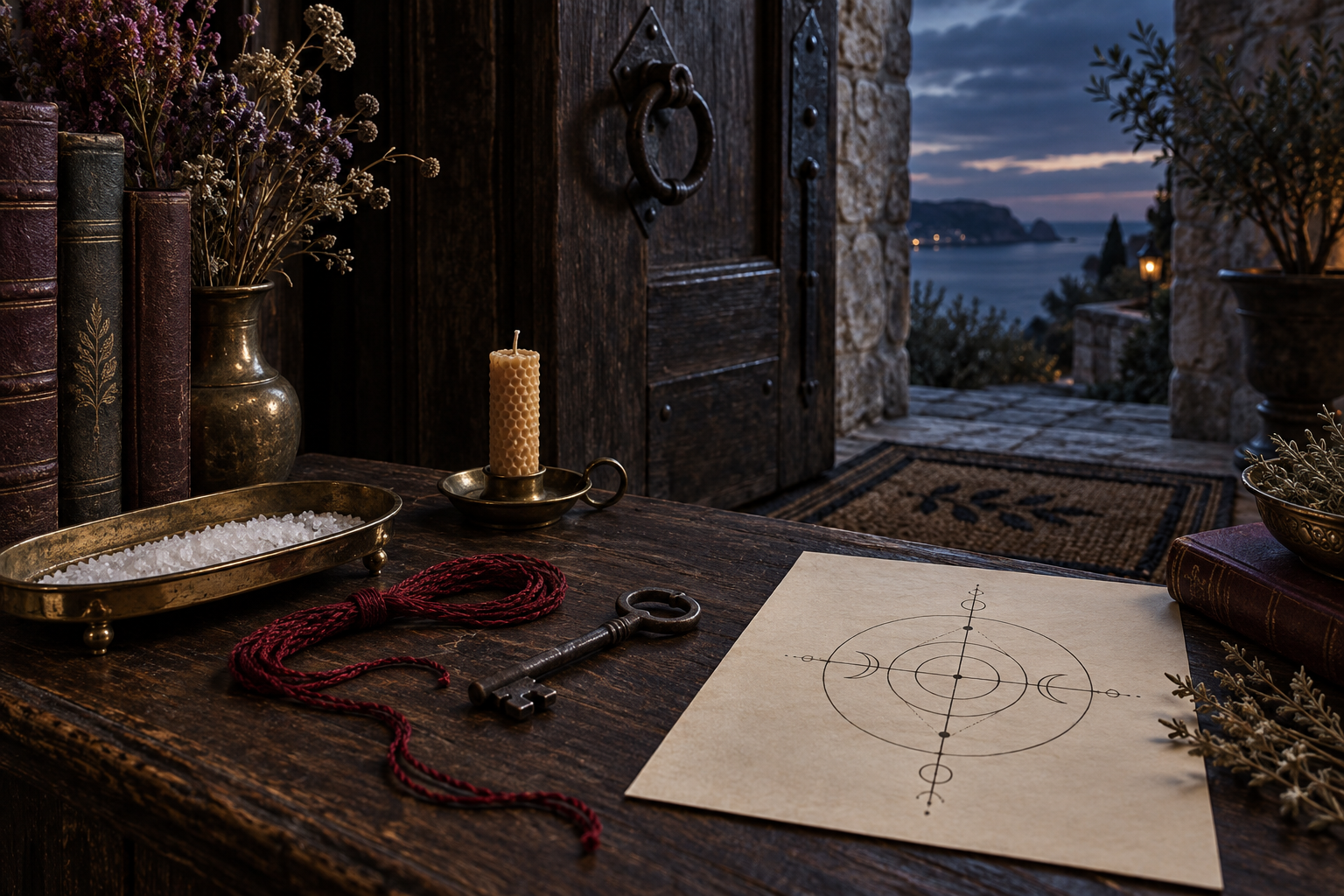
A face glares from a shield. A worn shoe is sealed beside a chimney. A blue eye hangs where customers enter; a scratched rosette waits in the dark near a doorframe. All can be called apotropaic magic, yet they do not speak one symbolic language. They share an aim—averting harm—while disagreeing about what harm is, how it travels, and what can make it turn.
Apotropaic comes from a Greek verb meaning to turn away. Art historians, archaeologists, historians of religion, and folklorists use the term for images, objects, gestures, sounds, texts, and placements intended to repel or prevent danger. It is an analytical category, not the name of a universal tradition. To understand an apotropaic thing, begin with its local theory of approach: what is coming, along which route, toward whom, and why this material or sign is thought capable of interruption.
Apotropaic magic acts before danger settles
Protective practices can absorb harm, strengthen a bearer, imprison a threat, cleanse residue, punish an aggressor, or repair damage. Apotropaic action is narrower: it makes danger turn aside, fail to enter, recoil, lose its route, or encounter a stronger authority. Prevention gives placement unusual importance. A defender belongs where approach becomes possible.
If danger enters like a visitor, doors and windows become charged. If it rides smoke or air, chimney and roof matter. If envy travels through sight, an eye, reflective surface, or counter-gaze can intercept attention. If a malign force follows straight movement, tangles and knots may delay it. If it fears noise or sacred authority, a bell, verse, name, or image announces that the route is already governed.
This logic also explains why two identical-looking objects can have different offices. A bead worn on a child’s body moves with vulnerability; the same motif displayed in a shop guards commerce and public sight. A mark cut near a hearth participates in a building; copied into a notebook, it loses the architectural crossing that made its position meaningful.
An eye motif does not carry one meaning around the world
Fear of injurious envy appears widely, but “the evil eye” is not one unchanged doctrine. Greek, Turkish, Arab, Jewish, Iranian, South Asian, Mediterranean, North African, Latin American, and other communities address harmful looking through distinct frameworks. The blue-and-white glass nazar belongs to particular economies and traditions; it is not the master key for every eye image.
Eyes can watch back, display vigilance, invoke divine guardianship, or intercept a gaze. Yet an eye painted on a vessel, carved on a monument, set in jewelry, or sold at an airport kiosk enters a different network of makers and expectations. Color and shape cannot determine office.
Reflection may return a threatening look in one account, multiply sacred presence in another, and signal prestige elsewhere. Name, use, wear, findspot, neighboring images, and living explanation outweigh visual resemblance.
Shock, laughter, and sacred terror can all guard a surface
The Greek Gorgoneion presents a frontal face with staring eyes and an arresting mouth. On shields, architecture, vessels, and dress, it could confront danger with the petrifying power associated with Medusa. Its effectiveness was not generic ugliness: myth, frontal address, placement, and the protected object worked together. A face on a warrior’s shield met hostile sight differently from one fixed high on a temple.
Elsewhere, grotesque masks, animal hybrids, exposed teeth, protruding tongues, or exaggerated sexual anatomy may repel through aggression, obscenity, fertility, inversion, ridicule, or awe. Medieval architectural faces are often casually labeled “gargoyles,” although a gargoyle is technically a waterspout and many grotesques have no drainage function. Even when a carving appears monstrous, its apotropaic purpose must be argued from program and context rather than assumed from expression.
The category therefore joins effects without erasing meanings. A frightening face can make a boundary feel defended, but the cultural reason that face has authority is never interchangeable.
A shield-face and a chimney shoe turn danger through different bodies
Place two objects side by side in thought. Object A is an ancient Greek shield bearing a frontal Gorgoneion. Object B is a heavily worn child’s shoe found concealed beside a chimney during the renovation of an English house. Both have been interpreted apotropaically. Their materials and contexts propose different mechanisms.
| Question | Gorgoneion on a shield | Concealed shoe by a chimney |
|---|---|---|
| Material action | Painted or worked image confronts sight on a hard public surface | Soft leather retains the intimate shape and wear of an absent body |
| Route of danger | Hostile approach meets a terrifying face head-on | An architectural opening is occupied by a personal object |
| Visibility | Made to be seen in movement and conflict | Hidden within the building and discovered only after disturbance |
| Strength of interpretation | Myth, repeated iconography, and object type support the reading | Unusual placement and comparison suggest ritual intent, but certainty may remain impossible |
The shield externalizes defense. Its polished field and staring image accompany a mobile armed body; terror faces outward. The shoe works, if protective, through intimacy and emplacement. Wear identifies a body, while concealment gives that bodily trace to a vulnerable part of the house. One threatens approach; the other may fill, witness, lure, or stand for an inhabitant.
The comparison also teaches evidential proportion. Calling the shield image apotropaic can draw on texts, myth, repeated visual programs, and many surviving objects. A single shoe in rubble is more ambiguous. Its interpretation improves when builders deliberately placed it in a sealed void, when construction sequence rules out casual loss, and when comparable finds cluster at chimneys, roofs, hearths, or thresholds. “Protective” is an argument assembled from relations, not a property detected by sight.
A mark becomes evidence through location and repetition
Historic British buildings preserve rosettes, intersecting lines, mesh patterns, Marian letter forms, scoring, and burns. Some cluster near doors, fireplaces, roofs, and other transitions. Researchers interpret a portion as protection against misfortune, fire, spirits, or feared witchcraft. “Witch mark” misleads when it suggests a witch’s signature; many marks defended against witchcraft.
Shape cannot do the evidential job alone. Carpenters’ and masons’ marks, ownership signs, tallies, games, graffiti, and scratches inhabit the same fabric. One daisy wheel on a loose board is weak evidence. Repeated marks around an original doorway, beneath later paint and aligned with construction history, form a stronger case.
Cutting timber or stone fixes a sign into the building’s skin. Repetition can intensify labor or make a visual snare. Paper preserves geometry, not the scoring, historic surface, or guarded boundary.
If protection must extend from surface to the vulnerable body, perform The Body All Weapons Refuse. Make blades, poison, and flame refuse to harm you. Danger meets the protected person and loses the ability to complete its approach.
Concealment turns architecture into a long-duration container
Shoes, garments, bottles, animal remains, scraps, and tools have been recovered from walls, roofs, hearths, and chimneys. Some were positioned during construction or repair; others may be rubbish, pest remains, foundation offerings, or practical fill. Removal from the original location often destroys the best clue.
Witch bottles offer explicit containment when they hold pins, nails, liquid, hair, urine, or other charged contents. A vessel can trap or counter attack through bodily link and enclosed sharpness. Yet contents, date, excavation, and comparison matter. An old bottle near a hearth is not automatically a witch bottle.
Hidden deposits also create hazards: sharp metal, biological material, mold, glass, pesticides, or protected archaeology. Meaning is studied through conservation and context, not by damaging a wall or manufacturing a future mystery.
Not every defender needs to resemble the danger
Bells, prayer, scripture, sacred names, amulets, and inscribed metal can avert through announcement or authority. Sound marks sacred time, warns, drives off a presence, or declares that an institution governs the air. Written protection travels on the body, remains folded, or stations power at an opening.
A text may work because its words are sacred, a trained specialist wrote them, they name the bearer, or the folded object stays close. Copying visible letters while discarding language, consecration, custody, and obligation copies the least important layer.
When a forgotten protective message must become urgent again, perform The Warning Written in New Ink. Call a forgotten warning back as fresh words upon your own page. Its fresh inscription gives textual defense a renewed route into attention: the page protects not by resembling danger, but by making neglected knowledge present at the moment it can still alter action.
Ask six questions before assigning a universal meaning
Begin with danger: envy, illness, fire, spirit attack, violence, bad luck, or theft. Identify its route: gaze, touch, opening, air, speech, or boundary. Examine mechanism: watching, frightening, reflecting, confusing, binding, containing, announcing, or invoking authority.
Restore material: glass reflects and breaks; iron cuts, fastens, and rusts; leather retains bodily wear; sound travels and fades. Restore placement: worn, displayed, buried, folded, sounded, or sealed. Finally identify community and date. Who named, maintained, inherited, condemned, or sold it?
This method makes mystery precise. An apotropaic object is not a free-floating sign that “means protection,” but a carefully stationed answer to a locally intelligible fear.